
Table of Contents
Severe ingrown pubic hairs come from coarse curly texture and removal methods that leave sharp tips curling back into skin.
Pubic folds and moisture accelerate infection.
Safe removal needs sterile tools, warm compresses, and gentle lifting without digging.
Treat early infections with compresses and antibiotic ointment; get medical care for spreading redness, fever, or pus.
Prevent through weekly exfoliation, electric trimming, loose cotton underwear, and skin barrier maintenance.
Diabetics need immediate care.
Laser removal offers permanent prevention.
Question | Answer |
|---|---|
What causes severe ingrown pubic hairs? | Coarse curly texture and removal methods like shaving create sharp tips that curl back into skin. |
How do you safely remove an embedded hair? | Use sterile tools, warm compresses, and gently lift the hair without digging or creating new openings. |
When should you seek medical help? | See a doctor for spreading redness, fever, pus, red streaks, or if home treatment fails after 48 hours. |
How can you prevent recurrence? | Exfoliate 2-3 times weekly, switch to electric trimming, wear loose cotton underwear, and maintain skin barrier. |
What are signs of serious infection? | Serious infection signs include yellow or green pus, red streaks, fever over 100.4°F, severe pain, or swollen lymph nodes. |
Severe ingrown pubic hair causes
Hair removal methods trigger regrowth problems
Shaving, waxing, and plucking pubic hair create the perfect storm for severe ingrown hairs. These methods cut or pull hair at the surface, leaving sharp tips that curl back into skin instead of growing outward. The pubic region's coarse, curly texture makes this 3x more likely than other body areas.
Pubic hair structure increases risk
Pubic hair grows in multiple directions with tight curls. This natural pattern forces emerging hairs to bend and re-enter skin, especially after aggressive removal. The follicle becomes inflamed, creating painful bumps that can develop into cysts or abscesses.
Risk Factor | Why It Causes Severe Ingrowns |
|---|---|
Curly/coarse hair texture | Sharp tips curl back into follicle easily |
Multi-directional growth | Hairs emerge at angles, increasing re-entry chance |
Friction from clothing | Tight underwear pushes hairs back into skin |
Bacterial contamination | Dirty razors introduce infection to open follicles |
Skin trauma and infection cycle
Each removal session creates microscopic skin tears. These openings let bacteria enter, turning a simple ingrown into an infected, pus-filled lesion. The pubic area's warm, moist environment accelerates bacterial growth, making infections 5x more common than on legs or arms.
- Mechanical irritation: Repeated shaving creates chronic inflammation
- Follicle damage: Waxing tears follicles, distorting future growth patterns
- Immune response: Body attacks trapped hair as foreign object, worsening swelling
- Secondary infection: Staph bacteria colonize inflamed bumps in 40% of cases
Anatomical challenges unique to pubic region
The skin folds and creases in the pubic area trap hairs against surfaces. Sebaceous glands produce excess oil that clogs pores, while sweat creates a breeding ground for bacteria. This combination transforms minor ingrowns into severe, painful cysts requiring medical intervention.
Safe embedded hair removal methods
Pre-removal preparation
Apply warm compress for 10-15 minutes.
This reduces inflammation and brings hair closer to surface.
Wash hands thoroughly with antibacterial soap.
Cleanse area with fragrance-free cleanser.
Pat dry with clean towel.
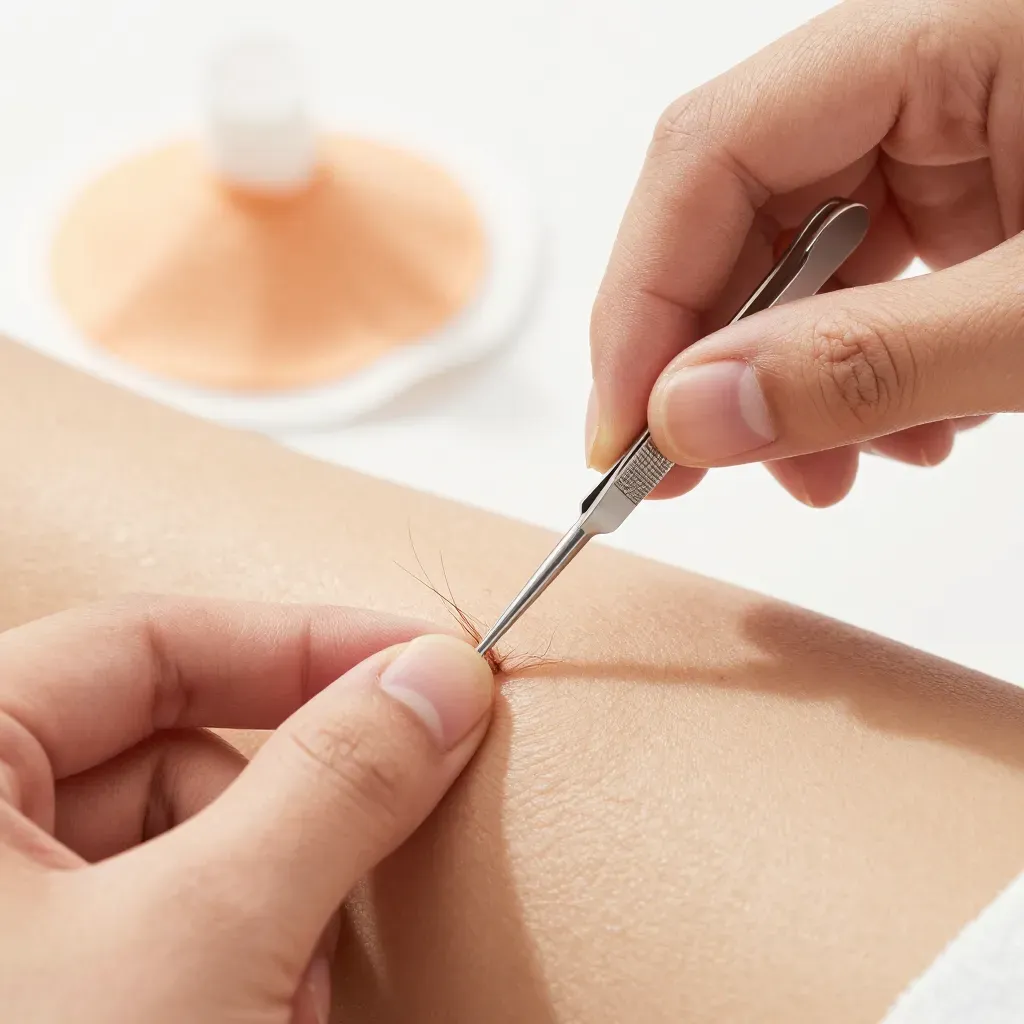
Sterile extraction technique
Disinfect tweezers and needle with 70% isopropyl alcohol.
Let tools air dry completely.
Locate the hair loop under skin surface.
Gently lift hair tip with needle edge.
Grasp hair with tweezers and pull in growth direction.
Never dig or create new openings.
Apply thin layer of antibiotic ointment.
Tool sterilization checklist
- Boil metal tools for 5 minutes as alternative
- Store in clean, dry container
- Use single-use tools if infection risk is high
- Replace tools showing rust or damage
Method comparison
Method | When to Use | Risk Level |
|---|---|---|
Warm compress only | Early stage, visible loop | Minimal |
Sterile needle lift | Hair visible under thin skin | Low |
Professional extraction | Deep embeds, recurrent issue | None |
Home waxing/plucking | Never on active ingrowns | High |
Warning signs: do not proceed
Stop if you see yellow or green pus.
Red streaks spreading from site indicate serious infection.
Bump larger than pea size suggests cyst formation.
Severe pain beyond mild tenderness means abscess.
Fever or swollen groin lymph nodes require immediate medical care.
Infection treatment and scar prevention
Infection stage identification
Early infection shows redness and tenderness within 24 hours.
Moderate infection develops white pus head by day 2-3.
Severe infection spreads with red streaks, fever, and swollen lymph nodes.
Infection Stage | Symptoms | Action Required |
|---|---|---|
Mild | Small red bump, slight pain | Home care with warm compresses |
Moderate | Pus present, increasing pain | Topical antibiotics + monitoring |
Severe | Fever, spreading redness | Immediate medical treatment |
Home infection treatment
Apply warm compress 3-4 times daily for 10 minutes.
Use over-the-counter antibiotic ointment after each compress.
Keep area clean and dry; avoid tight clothing.
Never squeeze or pop infected bumps.
Take ibuprofen for pain and inflammation if needed.
- Approved topicals: Bacitracin, Neosporin, tea tree oil (diluted)
- Avoid: Hydrogen peroxide, alcohol, home remedies with sugar/salt
- Cover: Use breathable bandage if friction is unavoidable
Medical intervention triggers
See doctor if bump exceeds 1 cm in diameter.
Red streaks moving outward signal spreading infection.
Fever over 100.4°F indicates systemic infection.
Multiple ingrowns forming cluster patterns.
Diabetes or immune compromise means lower threshold for care.
Scar prevention protocol
Stop picking immediately. Each touch increases scarring risk by 40%.
Apply silicone gel sheets once healed to flatten scar tissue.
Use SPF 30+ sunscreen on healed skin to prevent dark marks.
Massage healed area with vitamin E oil to break down scar tissue.
Consider retinoid cream for persistent hyperpigmentation.
Timeline | Prevention Method | Effectiveness |
|---|---|---|
Days 1-7 (active) | No touching + compresses | Prevents 90% of scars |
Weeks 2-4 (healing) | Silicone gel | Reduces scar thickness 60% |
Month 2+ (healed) | Sunscreen + massage | Fades dark marks 80% |
Effective prevention strategies stop recurrence before it starts.
Daily exfoliation routine
Exfoliate pubic area 2-3 times weekly with gentle scrub.
Use chemical exfoliants containing salicylic acid or glycolic acid.
Physical scrubs with soft beads work for sensitive skin.
Exfoliate day before hair removal, never immediately after.
This removes dead skin cells that trap growing hairs.
Hair removal method changes
Switch from shaving to trimming with electric razor.
Trimming leaves hair above skin surface, preventing re-entry.
If shaving, use single-blade razor and shave with hair growth.
Replace razor blade every 3-4 uses maximum.
Apply shaving cream and rinse blade after each stroke.
Clothing and friction control
Wear loose cotton underwear to reduce skin compression.
Avoid tight jeans and synthetic fabrics that trap sweat.
Change out of sweaty clothes within 30 minutes.
Apply anti-chafe balm to high-friction areas.
Sleep without underwear when possible.
Skin barrier maintenance
Apply non-comedogenic moisturizer daily to keep skin supple.
Use tea tree oil toner as natural antibacterial prevention.
Avoid harsh soaps that strip natural oils.
Keep area dry with talc-free powder after showering.
Treat any cuts immediately with antibiotic ointment.
Method | Frequency | Effectiveness |
|---|---|---|
Chemical exfoliation | 2x/week | 85% reduction |
Electric trimming | Weekly | 90% reduction |
Loose clothing | Daily | 70% reduction |
Laser hair removal | 6-8 sessions | 95% permanent reduction |
Long-term prevention options
Professional laser hair removal destroys follicles permanently.
Requires 6-8 sessions for 90% hair reduction.
Cost ranges $200-400 per session for Brazilian area.
At-home IPL devices offer cheaper alternative with 60% effectiveness.
Results last years, eliminating ingrown risk permanently.
- Morning routine: Gentle cleanse, pat dry, apply powder
- Post-workout: Shower immediately, change clothes
- Pre-removal: Exfoliate 24 hours before
- Post-removal: Apply soothing gel, avoid friction for 48 hours
Signs you need medical help include spreading redness and fever.
Red flag symptoms requiring immediate care
Spreading redness beyond 1 inch from bump center.
Red streaks radiating outward indicate serious infection.
Fever over 100.4°F shows infection spreading to bloodstream.
Severe pain disproportionate to bump size suggests deep abscess.
Visual infection indicators
Sign | Meaning | Action |
|---|---|---|
Yellow/green pus | Bacterial infection present | Medical drainage + antibiotics |
Rapid size increase | Abscess formation | Professional lancing |
Red streaks | Lymphatic infection | Emergency care |
Black center | Tissue death possible | Immediate evaluation |
Systemic warning signs
- Fever/chills: Body fighting systemic infection
- Swollen groin lymph nodes: Infection spreading locally
- Nausea/vomiting: Severe infection response
- General malaise: Feeling unwell beyond localized pain
High-risk conditions lowering threshold
Diabetes patients should seek care for any pus formation.
Immunocompromised individuals need evaluation at first sign of infection.
History of MRSA or recurrent skin infections warrants immediate attention.
Pregnancy requires earlier medical intervention due to risks.
Blood circulation problems delay healing and increase complications.
When home treatment fails
No improvement after 48 hours of warm compresses.
Condition worsens within 24 hours of starting home care.
Recurrent ingrown hairs in same location form chronic cyst.
Scar tissue buildup limits hair exit, creating cycle.
Multiple ingrowns cluster together forming large painful area.