
Table of Contents
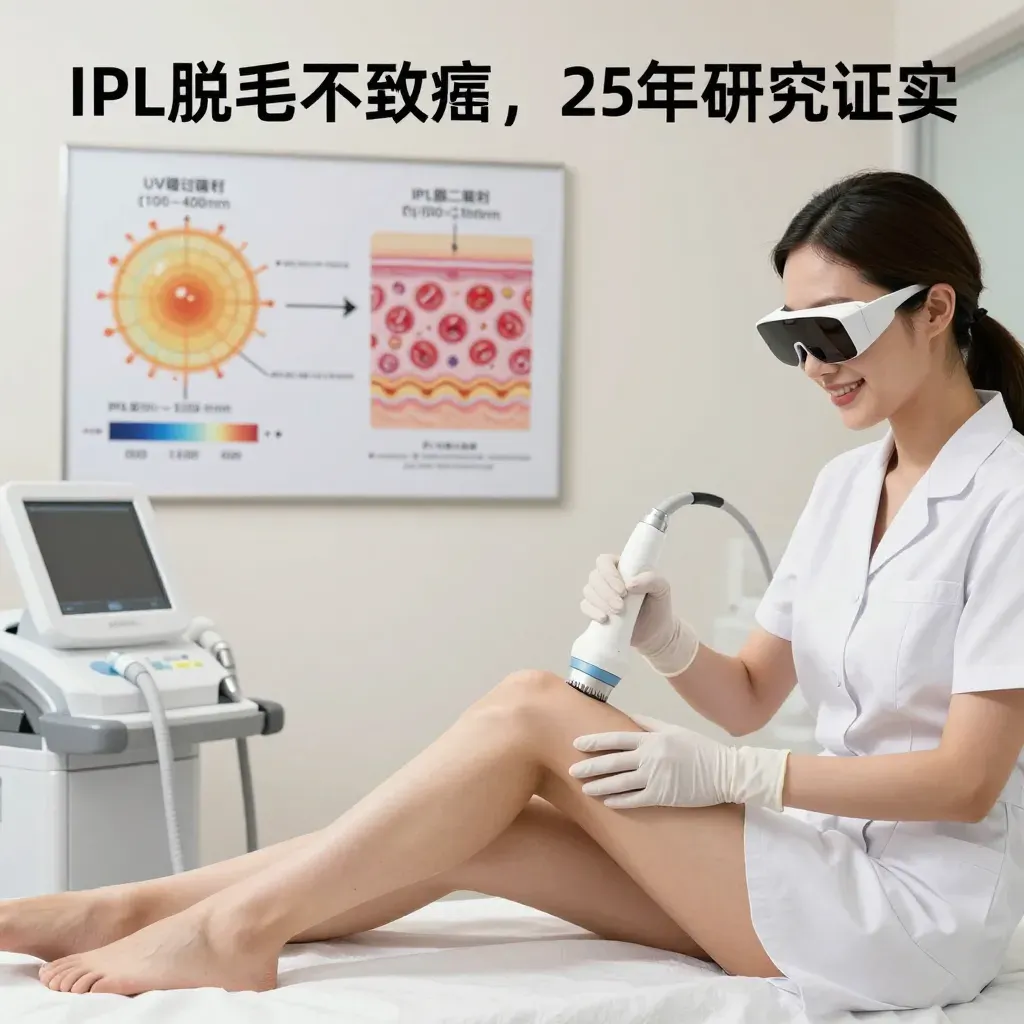
IPL hair removal uses broad-spectrum light between 500-1200nm to heat and disable hair follicles through melanin absorption. Unlike UV radiation which damages DNA at 100-400nm, IPL operates well above that range and uses non-ionizing radiation that cannot affect DNA. Over 25 years of research confirms no link between IPL and skin cancer, with studies showing zero thymine dimer formation or tumor development from IPL alone. Real side effects include temporary redness, rare blistering, and pigment changes—not cancer. Safe use requires avoiding sun exposure pre-treatment, wearing eye protection, and getting suspicious moles checked by a dermatologist first.
Question | Answer |
|---|---|
Does IPL hair removal cause cancer? | No, 25+ years of research shows no evidence linking IPL to skin cancer. |
Is IPL light the same as UV radiation? | No, IPL uses 500-1200nm wavelengths while harmful UV sits at 100-400nm. |
What are the real side effects of IPL? | Common effects include redness and swelling, with rare cases of blistering or pigment changes. |
Can IPL damage DNA in skin cells? | No, IPL uses non-ionizing radiation that cannot break chemical bonds or damage DNA. |
How many IPL sessions do you need? | Most people need 6-12 treatments spaced 4-6 weeks apart for best results. |
How IPL hair removal technology actually works.
IPL stands for Intense Pulsed Light. It uses broad-spectrum light wavelengths between 500-1200nm to target melanin in hair follicles. Unlike lasers that use a single wavelength, IPL emits multiple wavelengths simultaneously.
The photothermolysis process
IPL devices fire quick pulses of light into the skin. Melanin in the hair shaft absorbs this light energy and converts it to heat. This heat damages the follicle, inhibiting future hair growth. The surrounding tissue stays unharmed.
- Light pulses penetrate the skin surface
- Melanin in hair absorbs the light energy
- Heat builds up and disables the follicle
- Hair sheds naturally over 1-3 weeks
IPL wavelength range vs other light sources
Light Source | Wavelength Range | DNA Impact |
|---|---|---|
UV Radiation (Sun) | 100-400nm | Causes DNA damage |
IPL Devices | 500-1200nm | No DNA impact |
Visible Light | 400-700nm | No DNA impact |
Infrared | 700nm+ | No DNA impact |
Why IPL targets hair specifically
IPL relies on selective photothermolysis. Melanin absorbs light more intensely than surrounding tissue. This selective absorption heats the follicle while sparing the skin. FDA-cleared IPL devices include built-in filters blocking wavelengths below 500nm, removing any UV exposure risk.
Multiple sessions are needed because IPL only affects hair in the active growth phase. Most people need 6-12 treatments spaced 4-6 weeks apart for optimal hair reduction results.
The difference between IPL light and UV radiation.
IPL and UV radiation are fundamentally different types of light. UV radiation from sunlight causes skin damage and cancer. IPL uses controlled visible and infrared light that does not penetrate deep enough to affect DNA.
Understanding UV radiation
UV radiation falls between 100-400nm on the light spectrum. It penetrates skin cells and causes direct DNA damage, leading to mutations that result in skin cancer over time. UV damages thymine bases in DNA, creating thymine dimers that can become cancerous.
How IPL differs
IPL operates between 500-1200nm, well above the harmful UV range. FDA-cleared IPL devices filter out all wavelengths below 500nm. IPL uses non-ionizing radiation, which cannot break chemical bonds or damage DNA.
Factor | UV Radiation | IPL Treatment |
|---|---|---|
Wavelength | 100-400nm | 500-1200nm |
Radiation Type | Ionizing | Non-ionizing |
DNA Impact | Direct damage | No impact |
Cancer Risk | Proven risk | No evidence |
DNA Damage | Thymine dimers | None |
Why this matters
Only wavelengths below 400nm cause direct DNA damage. IPL wavelengths are 100nm or more above this threshold. The light energy in IPL converts to heat, targeting melanin selectively without reaching cell nuclei where DNA resides.
- UV breaks chemical bonds in DNA directly
- IPL heats tissue without molecular damage
- UV causes sunburn and cell mutations
- IPL destroys follicles through thermal selective heating
Every FDA-cleared IPL system includes filters that block UV wavelengths entirely. This built-in protection makes professional IPL treatments fundamentally different from sun exposure.
What scientific research says about IPL cancer risks.
Extensive scientific research consistently shows IPL does not increase cancer risk. A comprehensive 2017 review in Lasers in Medical Science analyzed over 25 years of data and found no evidence linking IPL to skin cancer.
Key research findings
Multiple peer-reviewed studies confirm IPL safety:
- Sorg et al. (2007) found no thymine dimer formation after IPL exposure, proving no DNA damage occurred.
- Hedelund's mouse study (2006) showed tumors developed only in UV-exposed groups, not IPL-only groups.
- Chan et al. (2007) documented 52 IPL treatments over 6 months with no tumor formation.
- Springer review found no increased carcinogenicity even after repeated high-intensity exposures.
Long-term safety data
Study | Duration | Findings |
|---|---|---|
PMC Review (2017) | 25+ years | No cancer concerns, only anecdotal melanoma cases |
Chan et al. (2007) | 6 months, 52 treatments | No toxicity or tumor formation |
Hedelund et al. (2006) | Animal study | Tumors only with UV, not IPL alone |
Expert consensus
Major medical organizations agree:
- American Academy of Dermatology: IPL procedures are low-risk and don't contribute to cancerous cells.
- Acıbadem Healthcare Group: IPL does not use UV radiation and light energy doesn't penetrate deep enough to affect DNA.
Research shows IPL may even help treat precancerous actinic keratosis, with studies showing 68% resolution after one treatment.
Real side effects of IPL hair removal treatments.
IPL hair removal is generally safe when performed correctly, but it can cause side effects ranging from mild to rare complications.
Common Temporary Reactions
- Redness and swelling: Immediate post-treatment response, lasting hours to days.
- Mild discomfort: Tingling or warm sensation during and after pulses.
- Hair shedding: Treated hair falls out naturally within 1-3 weeks.
Potential Complications
Side Effect | Frequency | Key Details |
|---|---|---|
Blistering and burns | Rare but possible | From incorrect settings or poor technique; may cause skin injury. |
Pigment changes | Occasional | Hyperpigmentation (darkening) or hypopigmentation (lightening); often temporary but can be permanent. |
Scarring | Rare | Higher risk with keloid-prone skin; usually results from severe burns. |
Eye injury | Rare but possible | IPL light damages eyes; protective eyewear required for patient and operator. |
Risk Factors
Increased likelihood of side effects with:
- Darker skin tones: Higher melanin absorption raises burn and pigment change risk.
- Recent sun exposure or tanned skin: Skin sensitivity is elevated.
- Unqualified practitioners: Incorrect device parameters or technique.
- Photosensitizing medications: Certain drugs increase burn susceptibility.
Critical Safety Considerations
While burns do not increase long-term cancer risk, misdiagnosing a malignant melanoma as a benign lesion and treating it with IPL could delay proper cancer treatment. A pre-treatment dermatologist evaluation is essential to identify suspicious moles.
IPL may also treat precancerous actinic keratosis, with studies showing up to 68% resolution after one session.
Simple safety tips for IPL hair removal users.
Safe IPL hair removal starts with preparation and choosing qualified providers. Follow these guidelines to minimize risks and maximize results.
Before Treatment
- Avoid sun exposure and tanning for 2-4 weeks before treatment.
- Discontinue retinoids, acids, and exfoliating products 3-5 days prior.
- Remove all makeup, creams, and self-tanners from treatment areas.
- Have a dermatologist evaluate any suspicious moles before IPL.
- Choose a licensed, experienced practitioner for professional treatments.
During Treatment
- Wear provided protective eyewear at all times.
- Confirm the practitioner wears proper eye protection.
- Communicate any discomfort immediately during pulses.
- Verify the device is FDA-cleared and properly calibrated.
After Treatment
- Apply broad-spectrum SPF 50 sunscreen daily.
- Avoid heat, sweating, and strenuous exercise for 24-48 hours.
- Skip exfoliating products for 3-5 days post-treatment.
- Expect redness and swelling; apply cool compresses if needed.
- Dark spots will darken before naturally flaking off.
Who Should Avoid IPL
Condition | Reason |
|---|---|
Pregnancy or breastfeeding | Safety not established |
Active skin infections | Risk of worsening infection |
Recent Accutane use (6 months) | Increased skin sensitivity |
History of keloid scars | Higher scarring risk |
Light sensitivity disorders | Potential adverse reactions |