
Table of Contents
Cyst ingrown hairs form fluid-filled sacs under skin from trapped follicles creating lumps larger than 5mm.
Early signs include firm lumps, visible hair loops, increasing pain, and possible pus formation.
Apply warm compresses at 105-110°F for 10-15 minutes, 3-4 times daily for 2-3 days to soften.
Seek professional treatment for severe pain, spreading redness, fever, cysts over 1cm, or face/genital location.
Prevent by shaving with grain, exfoliating 2-3 times weekly, wearing breathable clothing, and considering laser hair removal.
Laser treatment reduces recurrence from 34% to 10% and destroys follicles permanently.
Watch for infection: red streaks, fever over 100.4°F, rapid swelling, foul odor.
Infections spread to bloodstream within 48-72 hours and can cause sepsis without treatment.
Question | Answer |
|---|---|
What makes an ingrown hair a cyst? | A cyst forms when trapped hair creates a fluid-filled sac larger than 5mm that keeps growing. |
How do you treat cyst ingrown hairs at home? | Apply 105-110°F warm compresses for 10-15 minutes, 3-4 times daily for 2-3 days. |
When should you see a doctor? | Get medical care for severe pain, spreading redness, fever, cysts over 1cm, or face/genital location. |
What prevents cyst ingrown hairs most effectively? | Laser hair removal reduces recurrence from 34% to 10% by destroying follicles permanently. |
What infection signs need emergency care? | Red streaks, fever over 100.4°F, rapid swelling, or foul odor require immediate attention. |
Identify cyst ingrown hairs early
What makes it a cyst
A cyst ingrown hair forms when trapped hair follicle creates fluid-filled sac under skin. Regular ingrown hairs cause small red bumps. Cysts develop into larger lumps with defined borders. The body encapsulates trapped keratin and hair creating pocket that grows over days.
Early visual signs timeline
Day 1-2 | Initial bump appears, mild tenderness, hair tip visible as dark dot |
|---|---|
Day 3-5 | Firm lump forms, skin stretches tight, pressure sensation increases |
Day 6+ | Defined cyst sac, possible whitehead, pain with movement |
Infected stage | Yellow/green pus, warmth radiating, rapid size increase |
Key identification markers
- Size exceeds 5mm diameter and continues growing
- Deep lump you can feel but not fully see on surface
- Pain increases when sitting, walking, or pressure applied
- Hair loop visible at center under bright light or magnification
- Pus formation with foul odor indicates bacterial infection
- Skin color changes from red to purple if blood trapped
- Multiple bumps cluster in same area
High-risk body locations
Pubic area and bikini line create most cysts due to coarse curly hair and friction. Inner thighs rub together causing repeated irritation. Beard area on men produces painful cysts from shaving against grain. Underarms develop cysts from deodorant clogging and sweat. Lower legs get fewer cysts but still possible with waxing.
Who gets them most
- People with curly or coarse hair textures
- Those who shave against hair growth direction
- Individuals who wear tight synthetic clothing
- Anyone with recent waxing or aggressive hair removal
- People with high friction occupations (athletes, cyclists)
Act immediately if you see
Soften area with warm compresses
Why heat works
Heat softens skin layers above trapped hair. Warmth pulls blood to area. Blood brings healing cells. Heat opens pores. Hair moves toward surface for easier removal.
Proper compress technique
Soak clean washcloth in hot water. Wring out excess until damp not dripping. Place directly on cyst. Press gently. Hold steady. Rewarm when it cools. Repeat for full 15 minute session.
Temperature and timing schedule
Water temp | 105-110°F (40-43°C) |
|---|---|
Compress time | 10-15 minutes per session |
Frequency | 3-4 times daily |
Total days | 2-3 before extraction |
Materials needed
- Clean washcloth or small towel
- Hot water bowl
- Thermometer (optional)
- Phone timer
- Plastic wrap (optional)
Safety rules
Test temp on inner wrist first. Never use boiling water directly. Stop immediately if pain intensifies. Do not apply to broken skin. Keep area clean and dry between sessions. Avoid harsh soaps.
Expected results timeline
Day 1: Skin feels softer. Day 2: Cyst appears closer to surface. Day 3: Hair loop often emerges. No improvement after 3 days? Continue compresses but prepare for medical evaluation.
Recognize when professional treatment is necessary
Critical warning signs
- Severe pain, rapid swelling, or spreading redness
- Pus, foul odor, or fever indicates infection
- Cyst exceeds 1 cm or persists beyond 2-3 weeks
- Location on face, genitals, or high-movement areas
- Multiple recurrent cysts in same spot
- Failed home treatment after 3-5 days
- Underlying health conditions like diabetes
Professional removal procedures
Medical providers perform these sterile treatments:
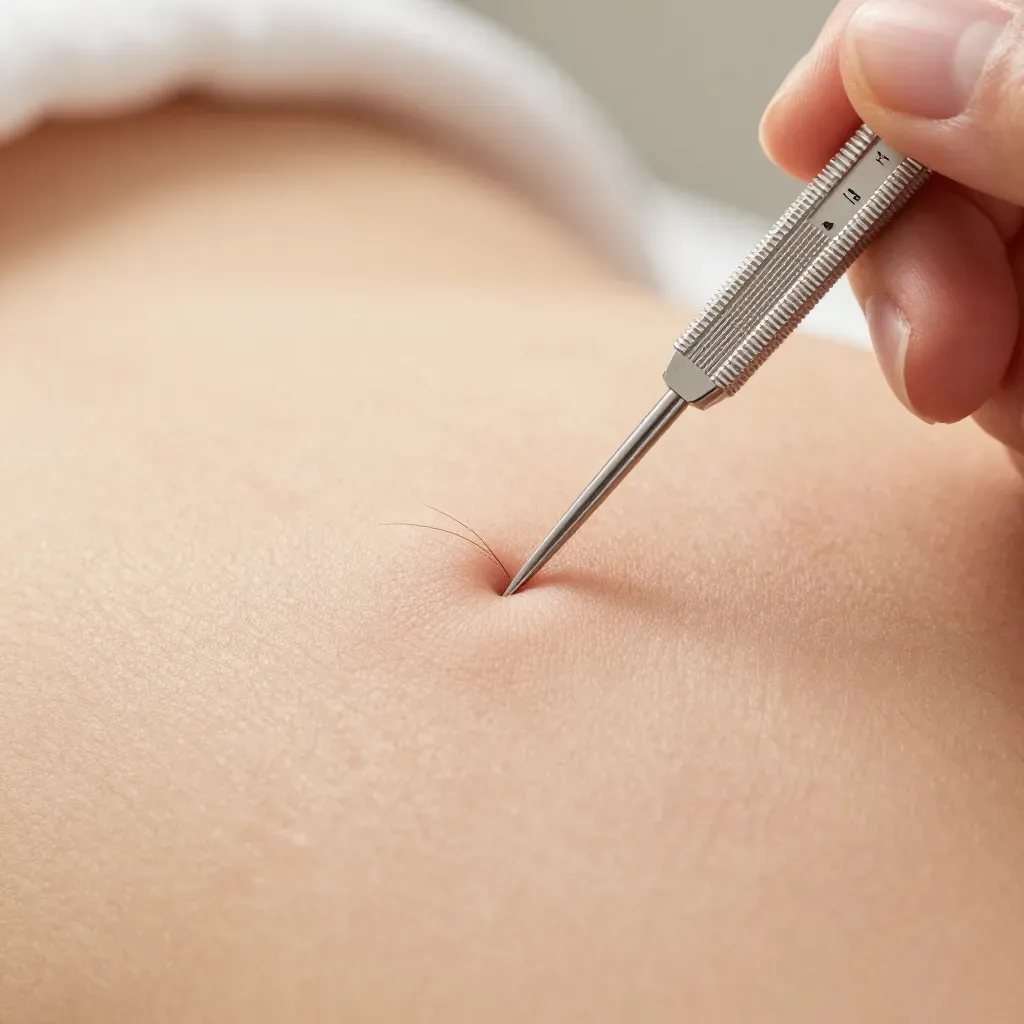
- Sterile needle extraction - lifts trapped hair for early cysts
- Incision and drainage - releases infected fluid
- Complete surgical excision - removes cyst capsule to prevent return
- Steroid injections - rapidly reduces inflammation
- Antibiotic therapy - treats active infection
- Laser hair removal - prevents future cysts by destroying follicles
Procedure comparison
Method | Best For | Success Rate | Recovery |
|---|---|---|---|
Sterile Extraction | Small, superficial cysts | 85% | 24-48 hours |
Incision & Drainage | Infected cysts | 90% | 3-7 days |
Surgical Excision | Recurrent/deep cysts | 95% | 1-2 weeks |
Laser Treatment | Prevention | 75% reduction | Same day |
What happens during medical removal
Doctor numbs area with local anesthetic, makes precise incision, removes hair and cyst contents, cleans cavity, and may close with stitches. The process takes 15-30 minutes. Surgical removal ensures complete cyst elimination.
Prevention through laser treatment
Consider laser hair removal for recurring cysts. Studies show it reduces recurrence from 34% to 10% after one year. Effective for bikini line, face, and other problem areas.
Prevent future cyst ingrown hairs effectively
Master proper hair removal technique
Shave with the grain, not against it.
Use sharp single-blade razors only.
Apply thick shaving cream or gel.
Replace blades after 3-5 uses maximum.
Consider electric trimmers instead of razors.
Try depilatory creams as chemical alternatives.
Exfoliate consistently
Use chemical exfoliants 2-3 times weekly.
Salicylic acid dissolves dead skin cells.
Glycolic acid unclogs hair follicles.
Physical exfoliation works with soft washcloths.
Focus on problem areas: bikini line, face, underarms.
Avoid over-exfoliating which irritates skin.
Maintain skin hydration and protection
Apply non-comedogenic moisturizer daily.
Use tea tree oil for natural antibacterial protection.
Benzoyl peroxide prevents bacterial buildup.
Avoid heavy oils that clog follicles.
Wear breathable clothing
Choose loose cotton underwear.
Avoid tight synthetic fabrics.
Change out of sweaty clothes immediately.
Friction traps hairs under skin.
Consider permanent laser hair removal
Research shows laser treatment reduces cyst recurrence from 34% to 10% after one year.
Destroys follicles to prevent hair from growing inward.
Most effective for chronic sufferers.
Requires 6-8 sessions for optimal results.
Laser hair removal works best on dark hair.
Post-hair removal care routine
Step | Product | Timing |
|---|---|---|
Cleanse | Antibacterial wash | Immediately after |
Soothe | Aloe vera gel | Within 1 hour |
Protect | Loose clothing | 24 hours |
Prevent | Exfoliant | 48 hours later |
Long-term prevention strategy comparison
Method | Effectiveness | Cost | Maintenance |
|---|---|---|---|
Shaving technique | Medium | Low | Daily |
Exfoliation | Medium | Low | 2-3x/week |
Depilatory creams | Low-Medium | Medium | Weekly |
Laser removal | Very High | High | Yearly touch-ups |
At-home laser devices offer moderate prevention at lower cost.
Identify infection warning signs needing immediate medical attention
Visual infection indicators
- Redness spreading beyond cyst edges
- Yellow or green pus
- Black center or necrotic tissue
- Rapid size increase in 24 hours
- Red streaks outward
- Hot to touch
Systemic warning signs
- Fever over 100.4°F
- Chills, sweats, body aches
- Swollen lymph nodes
- Severe throbbing pain
- Difficulty moving area
- Weakness, malaise
High-risk patients
Risk Factor | Danger | Action |
|---|---|---|
Diabetes | Impaired immunity | Doctor within 24 hrs |
Immunosuppressed | Can't fight infection | ER same day |
Face/genital cyst | Sepsis risk | Doctor within 12 hrs |
MRSA history | Antibiotic resistant | Doctor same day |
Emergency red flags
- Fever over 102°F with rapid heart rate
- Confusion or altered mental state
- Cyst larger than 2 inches
- Difficulty breathing
- Red streaks toward heart
Complications timeline
- 24-48 hours: Abscess, cellulitis
- 3-5 days: Tissue death, scarring
- 5-7 days: Bloodstream infection
- 7+ days: Hospitalization, IV antibiotics
Medical treatment options
- Incision and drainage under sterile conditions
- Oral antibiotics for 7-10 days
- IV antibiotics for severe cases
- Complete surgical excision if recurrent
- Culture tests identify bacteria
For severe cases, surgical removal prevents recurrence. Chronic sufferers should consider laser hair removal to eliminate follicles permanently.