
Table of Contents
Deep ingrown hairs embed completely under skin forming firm nodules 2-5mm wide without visible tips.
They create tender bumps in high-friction areas like bikini line, underarms, and beard zone.
Watch for infection: pus, spreading redness, warmth, fever, or red streaks.
Never dig them out yourself—this pushes hair deeper, introduces bacteria, and causes 40% scarring risk.
Dermatologists extract them safely with sterile needles/blades for $100-300 per session with less than 2% scarring risk.
Home treatment works for non-infected bumps: apply warm compresses 10-15 minutes 3-4 times daily.
Use salicylic acid 2% or benzoyl peroxide 5% creams to dissolve dead skin and kill bacteria.
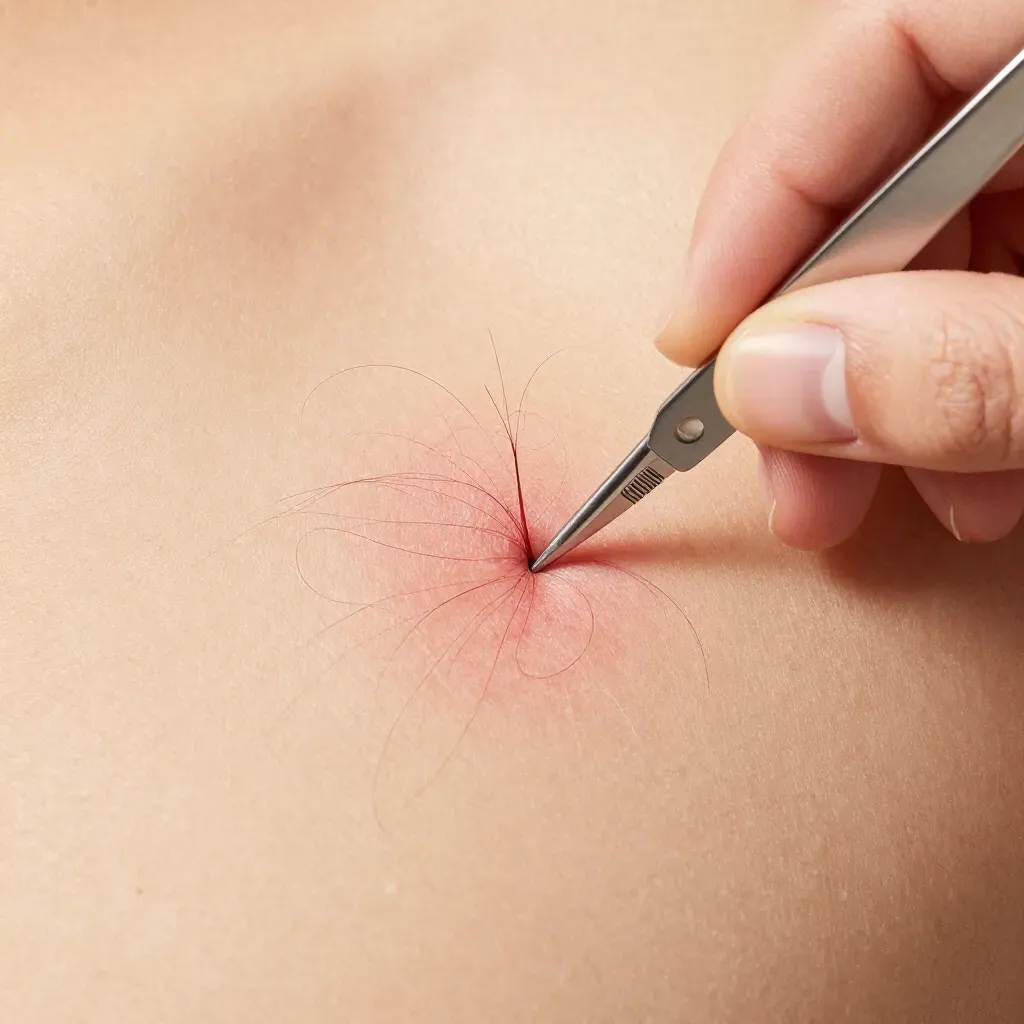
Only extract when hair tip surfaces using sterilized tweezers pulling in growth direction.
Prevent future ingrowns by shaving with single-blade razor following hair growth direction.
Exfoliate 2-3 times weekly with chemical exfoliants like salicylic acid.
Laser hair removal eliminates ingrowns permanently after 6-8 sessions costing $200-500 per area.
Seek medical care for cysts >5mm, bumps lasting >2 weeks, or any infection signs.
Surgical removal costs $150-400 with 98% success rate.
Early treatment prevents permanent scars and hyperpigmentation.
Question | Answer |
|---|---|
What are deep ingrown hairs? | Deep ingrown hairs are firm nodules that embed completely under skin without visible tips. |
What are infection warning signs? | Infection signs include pus, spreading redness, warmth, fever, and red streaks from the bump. |
Is DIY removal safe? | DIY removal pushes hair deeper and causes 40% scarring risk. |
How do dermatologists extract them? | Professionals use sterile needles/blades with magnification and forceps for safe removal. |
What prevents future ingrown hairs permanently? | Laser hair removal eliminates ingrowns permanently after 6-8 sessions. |
Identify deep ingrown hairs and infection risks before removal
Deep ingrown hairs embed completely under skin surface unlike superficial ones that show visible loops. They form when hair grows sideways into dermis layer instead of exiting follicle opening.
Visual identification markers
Look for raised bumps without visible hair tips. Deep ingrown hairs create firm nodules under skin. Color varies from flesh-toned to red or dark brown. Size ranges from 2-5mm diameter. Location often in high-friction areas like bikini line underarms beard zone. They feel tender when pressed and may cause localized itching or discomfort.
Superficial ingrown hair | Deep ingrown hair |
|---|---|
Visible hair loop above skin | No visible hair tip |
Small red bump | Firm nodule under skin |
Easy to extract with tweezers | Requires sterile needle/blade |
Heals in 3-5 days | Persists weeks without treatment |
Minimal pain | Tender to touch |
Infection warning signs
Infected deep ingrown hairs need medical attention. Do not attempt removal if you see:
- Pus or yellow drainage
- Increasing redness spreading beyond bump
- Warmth and throbbing pain
- Fever or general malaise
- Rapid growth beyond 5mm
- Multiple clustered bumps
- Red streaks radiating from site
- Scab formation with crusting
DIY removal risks
Attempting to dig out deep ingrown hairs pushes them further into skin. Non-sterile tools introduce bacteria. Forceful extraction damages surrounding tissue and creates scars. Picking at bumps spreads infection to nearby follicles. You risk post-inflammatory hyperpigmentation that requires prescription hydroquinone or steroid creams to treat. Thickened scars may need injectable steroids for improvement.
Deep ingrown hairs that persist longer than two weeks or show infection signs require professional extraction. Dermatologists remove them with sterile needles or blades and may prescribe steroid creams for swelling or antibiotics for active infection. They can also treat resulting discoloration with prescription bleaching creams or steroid blends.
High-risk areas include pubic region where moisture and friction increase infection likelihood. People with curly or coarse hair face higher deep ingrown hair risk due to natural curl pattern causing hair to re-enter skin.
Professional dermatologists use sterile tools for safe extraction
Dermatologists extract deep ingrown hairs with sterile medical instruments in clinical settings. This eliminates infection risk and prevents scarring that DIY attempts cause.
Medical-grade extraction tools
Doctors use sterile hypodermic needles 18-gauge or #11 surgical blades. They prep skin with antiseptic solution like povidone-iodine. Magnification loops or dermatoscopes locate buried hair shafts. Sterile forceps grasp and remove hair without breaking it. All tools are single-use or autoclaved.
Tool | Function |
|---|---|
Sterile needle/blade | Creates precise opening to access hair |
Antiseptic prep | Kills surface bacteria |
Magnification device | Finds exact hair location |
Sterile forceps | Extracts intact without damage |
Clinical extraction procedure
Doctor numbs area with local anesthetic for patient comfort. Makes micro-incision parallel to hair growth direction. Uses sterile technique to tease out coiled hair without digging. Procedure takes 5-10 minutes per lesion. Cleans wound and applies antibiotic ointment. Covers with sterile dressing.
Post-extraction medical care
Dermatologists prescribe steroid creams for swelling and inflammation. They prescribe oral antibiotics like doxycycline if infection present. Hydroquinone treats post-inflammatory hyperpigmentation. Injectable steroids like triamcinolone reduce thickened scars. Schedule follow-up appointments to ensure proper healing.
When professional extraction is mandatory
- Ingrown hair persists beyond 2 weeks
- Painful cyst formation larger than 5mm
- Signs of infection pus or spreading redness
- Recurrent ingrown hairs in same follicle
- Dark skin prone to keloid scarring
- Pubic or facial area with high visibility
- Multiple clustered bumps
Cost and outcomes
Professional extraction costs $100-300 per session depending on complexity. Insurance may cover if medically necessary. Results show immediate relief and complete hair removal. Healing completes in 7-14 days with proper care. Scarring risk drops to less than 2% compared to 40% with DIY methods.
Apply warm compresses and topical treatments at home
Warm compress technique
Apply warm compress to soften skin and draw hair toward surface. Use clean washcloth soaked in 105-110°F water. Hold on affected area 10-15 minutes. Repeat 3-4 times daily. Heat increases blood flow and opens pores. This encourages deep hair to migrate upward.
Effective topical treatments
Product | How it works | Application |
|---|---|---|
Salicylic acid 2% | Dissolves dead skin blocking hair | Once daily |
Benzoyl peroxide 5% | Kills bacteria reduces inflammation | Twice daily |
Hydrocortisone 1% | Reduces swelling and redness | Twice daily max 7 days |
Retinoid cream | Speeds cell turnover | Nightly |
Safe extraction protocol
Only attempt removal after hair tip becomes visible. Cleanse area with antibacterial soap. Apply warm compress 10 minutes. Sterilize tweezers with rubbing alcohol. Grasp visible hair and pull in growth direction. Do not dig into skin. If hair does not release easily stop and wait 24 hours. Apply antibiotic ointment after extraction.
Home treatment timeline
Days 1-3: Apply warm compresses and topical treatments. Days 4-7: Continue treatment hair should surface. Days 8-10: If no improvement seek professional help. Do not exceed 10 days of home treatment for deep ingrown hairs.
Stop immediately if you notice
- Pus or yellow drainage
- Redness spreading beyond bump
- Pain increases instead of decreases
- Skin feels hot to touch
- Multiple new bumps form
- No hair visible after 7 days
Home treatment works for deep but not infected ingrown hairs. Curly hair types see slower results. Pubic area requires extra gentleness. Stop all home attempts if infection signs appear and see dermatologist for sterile extraction.
Prevent future deep ingrown hairs with proper hair removal techniques
Hair removal methods ranked by ingrown risk
Method | Ingrown risk | Prevention tip |
|---|---|---|
Shaving | High | Use single-blade razor shave with grain |
Waxing | Medium | Exfoliate 48hrs before and after |
Depilatory creams | Low | Patch test first use sparingly |
Laser hair removal | Very low | Permanent reduction after 6-8 sessions |
Proper shaving technique
Shave after warm shower when hair softens. Apply shaving cream let sit 2 minutes. Use sharp single-blade razor. Shave in direction of hair growth only. Rinse blade after each stroke. Do not pull skin taut. Limit passes to one per area. Cold water rinse after shaving. Pat dry do not rub.
Exfoliation schedule
Exfoliate 2-3 times weekly with chemical exfoliants. Salicylic acid 2% dissolves dead skin cells. Glycolic acid 5% prevents follicle blockage. Avoid physical scrubs on sensitive areas. Increase frequency to daily for severe cases. Stop if irritation occurs.
Post-hair removal care
- Apply fragrance-free moisturizer immediately
- Wear loose cotton clothing for 24 hours
- Avoid touching picking at bumps
- Use tea tree oil as natural antibacterial
- Skip gym and swimming for 24 hours
Laser hair removal for prevention
Laser targets hair follicles to prevent regrowth. It eliminates ingrown hairs permanently after multiple sessions. Works best on dark hair light skin. Newer lasers treat all skin tones. Requires 6-8 treatments spaced 4-6 weeks apart. Costs more upfront saves money long-term.
Curly and coarse hair types benefit most from laser prevention. Pubic area sees 90% reduction in ingrowns after full treatment. Face and underarms respond well too. Maintenance sessions once yearly keep results. Laser hair removal stops ingrowns permanently.
Combine methods for best results. Shave less frequently. Wax only when hair reaches 1/4 inch. Use depilatory creams between laser sessions. Moisturize daily with non-comedogenic lotion. Choose best hair removal method for your skin type.
Track your hair removal schedule. Note which methods cause ingrowns. Adjust technique based on results. Prevention works better than repeated deep ingrown hair removal. Professional laser treatment costs $200-500 per area but eliminates the problem completely.
Seek medical attention for cysts or persistent inflammation
Cyst formation identification
Ingrown hair cysts form when trapped hair creates fluid-filled sac larger than 5mm. They feel like firm lump under skin. Cysts persist weeks to months without treatment. They may develop whitehead or remain skin-colored. Location determines urgency: facial cysts need immediate care. Pubic cysts risk rupture and infection.
Persistent inflammation red flags
- Bump present longer than 2 weeks
- Pain worsens instead of improves
- Redness spreads beyond original site
- Heat emanates from lesion
- Multiple bumps cluster together
- Scar tissue starts forming
- Hair never surfaces despite treatment
Medical procedures for cysts
Dermatologists perform incision and drainage for infected cysts. They inject local anesthetic first. Sterile scalpel makes small opening. Doctor removes hair and cyst wall completely. Packing material may be inserted for drainage. Surgical removal costs $150-400 per cyst. Insurance covers if medically necessary.
Treatment outcomes comparison
Approach | Healing time | Scarring risk | Success rate |
|---|---|---|---|
Home treatment | 10-14 days | 40% | 60% |
Professional extraction | 7-10 days | 2% | 95% |
Surgical cyst removal | 14-21 days | 5% | 98% |
Post-treatment medical care
Doctors prescribe oral antibiotics like doxycycline for 7-10 days. They apply prescription-strength steroid cream twice daily. Hydroquinone 4% treats post-inflammatory hyperpigmentation. Triamcinolone injections flatten thickened scars. Follow-up visits scheduled at 1 week and 1 month.
When to go to ER
Seek emergency care for fever over 101°F. Go if red streaks spread from lesion. Immediate attention needed for rapidly growing swelling. Face or genital area involvement requires urgent care. Find removal clinics for same-day appointments.
Delaying treatment allows cysts to enlarge. Untreated infections spread to bloodstream. Scarring becomes permanent after 6 months. Hyperpigmentation requires months of treatment. Early medical intervention prevents complications and reduces costs.