
Table of Contents
Embedded ingrown hairs grow sideways deep into skin creating painful hidden bumps under the surface.
Curly hair, close shaving, and tight clothing cause them.
Safe removal requires sterile tools, warm compresses, and precise extraction technique.
Prevent future issues by switching to single-blade razors, exfoliating regularly, and wearing loose clothing.
Question | Answer |
|---|---|
What is an embedded ingrown hair? | An embedded ingrown hair grows sideways deep into skin layers instead of upward, creating painful hidden bumps. |
How do you safely remove an embedded ingrown hair? | Cleanse the area, apply warm compresses, sterilize tools, pierce skin above the hair loop, grasp with tweezers, and pull in the hair growth direction. |
What causes embedded ingrown hairs? | Close shaving with multi-blade razors, waxing against hair growth, curly hair textures, tight clothing friction, and dead skin buildup block follicles. |
When should you see a doctor instead of removing at home? | See a doctor for active infection, diabetes, immune compromise, deep cystic bumps, large clusters, or if the area is near eyes or genitals. |
How can you prevent embedded ingrown hairs? | Use single-blade razors, shave with hair growth, exfoliate 3 times weekly with chemical exfoliants, wear loose cotton clothing, and consider laser hair removal. |
Identify embedded ingrown hairs and their causes
What Is an Embedded Ingrown Hair
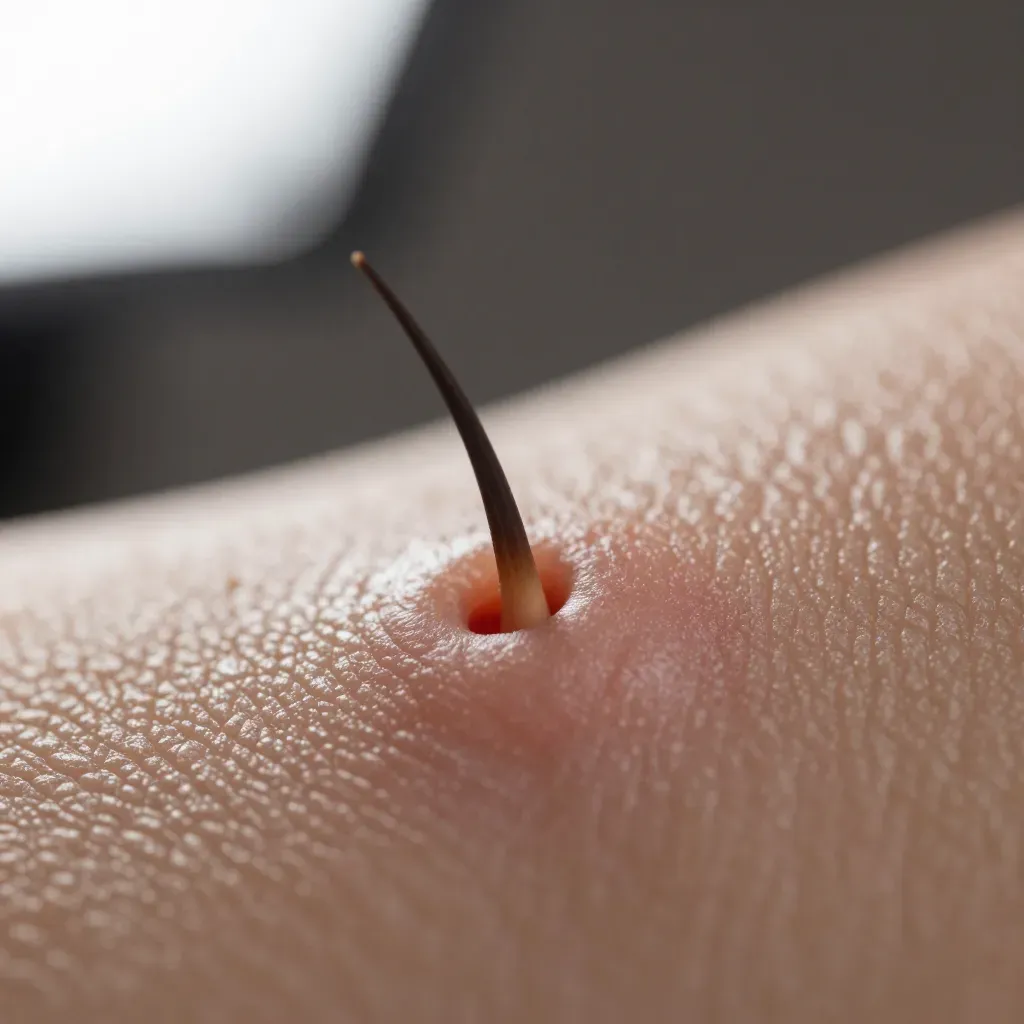
An embedded ingrown hair grows sideways deep into skin instead of upward.
It traps itself under skin layers causing inflammation and possible infection.
Unlike surface ingrowns, embedded ones hide beneath skin making embedded ingrown hair removal more difficult.
The hair shaft curls back into the follicle or surrounding tissue creating a painful bump that resists simple extraction methods.
Visual Identification Signs
Look for these markers:
- Red or dark bumps lasting over one week
- Pus-filled lesions with visible hair loop
- Pain when pressed
- Hyperpigmentation in high-friction zones
- Itching or burning around the bump
- Hard nodules under skin surface
Primary Causes
Common triggers include:
- Shaving too close with multi-blade razors
- Waxing against hair growth direction
- Curly/coarse hair textures that naturally bend back
- Tight clothing creating constant friction
- Dead skin buildup blocking follicles
- Pulling skin taut during hair removal
- Improper exfoliation routines
Risk Factors
Factor | Impact |
|---|---|
Curly hair | Natural coil redirects hair into skin |
Frequent shaving | Creates sharp tips that pierce skin |
Dry skin | Dead cells trap hair underneath |
Heavy sweating | Swollen pores allow hair redirection |
Scar tissue | Blocks normal growth path |
Genetic predisposition | Some skin types overproduce keratin |
Common Body Locations
Embedded ingrown hairs cluster in specific areas:
- Bikini line and pubic region
- Underarms
- Beard and neck area
- Lower legs and thighs
- Buttocks
These zones experience frequent friction and hair removal.
The combination creates perfect conditions for deep embedding.
Embedded ingrown hairs develop when removal methods cut hair at sharp angles.
The sharp tip pierces surrounding skin during growth.
Curly hair types face higher risk due to natural curl patterns.
Friction from athletic wear pushes hair deeper into follicles.
The body treats the trapped hair as a foreign object triggering inflammatory response and sometimes infection.
Prepare skin safely before removal
Cleanse area thoroughly
Wash with antibacterial soap and warm water for 60 seconds minimum.
Pat dry with clean paper towel never reused cloth.
Wipe entire area with 70% isopropyl alcohol wipe.
Let air dry completely before touching.
Cleanse twice if area is visibly dirty.
Work in well-lit clean area.
Soften skin and hair
Apply warm compress directly on bump for 10 minutes.
Hot shower steam softens skin in 15 minutes.
Epsom salt soak opens pores in 20 minutes.
Softening brings embedded hair toward surface.
Repeat process twice daily for stubborn hairs.
Use washcloth soaked in hot water as compress.
Add teaspoon of salt to compress for extra drawing effect.
Sterilize extraction tools
Boil tweezers and lancet needle for full 10 minutes.
Or soak metal tools in 70% rubbing alcohol 5 minutes.
Use medical-grade autoclave if available.
Never use fingers nails or dirty objects.
Wash hands with surgical scrub technique 30 seconds.
Wear sterile gloves for extra protection.
Place tools on clean paper towel after sterilizing.
Reduce inflammation first
Apply 1% hydrocortisone cream thin layer for 24 hours.
Take 400mg ibuprofen to decrease swelling.
Wait until redness subsides before any extraction.
Never attempt removal on infected skin.
Apply antibiotic ointment after successful removal.
Use ice pack if area is very swollen.
Stop if pain increases during preparation.
When to avoid home removal
Condition | Reason | Alternative |
|---|---|---|
Active infection | Spreads bacteria deep | See doctor for antibiotics |
Diabetes | Slow healing high risk | Professional extraction only |
Immune compromise | Infection risk too high | Medical office treatment |
Deep cystic bump | Scarring risk | Dermatologist cortisone shot |
Large cluster area | Systemic skin issue | Specialist evaluation |
Near eyes/genitals | Sensitive dangerous zone | Professional only |
Pus with fever | Systemic infection | Emergency care |
Extract embedded ingrown hairs step-by-step
Required tools
Gather these first.
- Sterile lancet needle (diabetic lancets work)
- Fine-point tweezers with sharp tips
- 70% isopropyl alcohol wipes
- Sterile cotton swabs
- Triple antibiotic ointment
- Small adhesive bandages
- 10x magnifying mirror or magnifying glass
- Bright direct lighting source
Step-by-step extraction
Execute in this exact order.
- Cleanse bump with alcohol swab for 30 seconds.
- Apply warm compress for 5 minutes to soften skin.
- Position magnifying mirror for precise visualization.
- Sterilize lancet by wiping with alcohol.
- Pierce skin directly above visible hair loop or dark spot.
- Create tiny 1mm puncture only - no deeper.
- Squeeze bump gently from sides using cotton swabs.
- Grasp exposed hair loop firmly with tweezers.
- Pull slowly in natural hair growth direction.
- Stop if hair resists or breaks under surface.
- Apply antibiotic ointment immediately after removal.
- Cover with bandage for 24 hours minimum.
Critical safety rules
Stop immediately if you encounter
- Bleeding that exceeds 2 minutes of direct pressure
- Pain that intensifies beyond initial lancet poke
- No hair visible after 3 gentle squeezing attempts
- Redness spreading outward from the bump site
- Pus release with foul odor
- Hair breaks under skin surface leaving fragment
- Severe swelling that obscures hair visibility
Post-extraction care protocol
Apply thin layer of antibiotic ointment twice daily for 3 days.
Keep area clean and completely dry except when applying ointment.
Refrain from shaving or waxing for minimum 48 hours.
Monitor site daily for infection signs.
Use hydrocolloid bandage if bump refills with fluid.
Switch to loose clothing to prevent friction.
Care for skin after removal
Immediate post-removal steps
Apply antibiotic ointment within 30 seconds.
Cover with sterile bandage immediately.
Keep bandage dry untouched for 24 hours.
Wash hands before any contact.
Daily care days 1-3
Cleanse twice daily with gentle fragrance-free cleanser.
Apply thin antibiotic ointment layer each time.
Use fresh sterile bandage after each cleaning.
Check for infection signs twice daily.
Keep area dry between cleanings.
Products: use vs avoid
Use | Avoid |
|---|---|
Antibiotic ointment | Alcohol toners |
Hydrocolloid bandages | Fragranced lotions |
Gentle cleansers | Exfoliating acids |
Petroleum jelly | Retinoids |
Loose cotton clothing | Tight synthetic fabrics |
Infection warning signs
Sign | Action |
|---|---|
Redness spreading beyond 1cm | See doctor |
Warmth or throbbing | Medical evaluation |
Pus or yellow drainage | Antibiotics needed |
Fever over 100.4°F | Emergency care |
Red streaks | Serious infection |
Swelling increases after day 2 | Professional treatment |
Healing timeline
Day 1-2: Redness and swelling normal.
Day 3-5: Bump flattens skin closes.
Day 7-10: Scab forms and falls off.
Day 14: Skin appears normal.
Dark marks may persist 4-8 weeks.
Scar prevention
Moisturize healed area daily.
Use silicone gel sheets if prone to scarring.
Apply SPF 30+ sunscreen daily.
Never pick scabs.
Add vitamin C serum after 2 weeks.
Doctor visit triggers
Hair remains after 2 extraction attempts.
Cystic lump forms under skin.
Recurrent ingrowns in same spot.
You have diabetes or immune issues.
Redness worsens after day 3.
Prevent future embedded ingrown hairs
Switch hair removal technique
Use single-blade safety razor instead of multi-blade cartridges.
Shave only in direction of hair growth never against.
Leave 1-2mm stubble visible above skin surface.
Replace blades after maximum 5 uses.
Consider electric trimmer for bikini and pubic areas.
Schedule laser hair removal sessions for permanent reduction.
Exfoliate on proper schedule
Apply chemical exfoliant 3 times weekly not daily.
Choose glycolic acid 5-10% or salicylic acid 2%.
Avoid physical scrubs with beads or rough particles completely.
Exfoliate night before hair removal never same day.
Wait 24 hours after shaving to resume exfoliation.
Prep skin before removal
Take hot shower minimum 10 minutes before shaving.
Massage pre-shave oil into damp skin as protective barrier.
Apply thick layer of shaving cream not gel.
Rinse blade after every single stroke.
Never pull skin taut excessively.
Post-removal care protocol
Apply cold compress immediately for 2 minutes.
Dab alcohol-free toner containing salicylic acid.
Moisturize with fragrance-free non-comedogenic lotion.
Wait 24 hours before applying deodorant to underarms.
Avoid tight clothing for 48 hours minimum.
Skip gym workouts that cause excessive sweating.
Clothing friction reduction
Wear This | Avoid This |
|---|---|
Loose cotton underwear | Tight synthetic fabrics |
Breathable gym shorts | Compression leggings |
Soft cotton tees | Rough seams |
Clean dry clothes | Sweaty workout gear |
Daily product routine
Morning: Gentle cleanser, lightweight moisturizer, SPF 30+.
Evening: Cleanser, chemical exfoliant 3x/week, moisturizer.
Pre-shave: Hot compress, pre-shave oil, shaving cream.
Post-shave: Cold compress, toner, antibiotic ointment.
Professional treatment options
See dermatologist if you experience 5+ ingrowns monthly.
Ask about prescription retinoids for prevention.
Consider laser hair removal for curly or coarse hair types.
Request professional extraction for deep cystic ingrowns.
Get bacterial culture test if infections recur frequently.