
Table of Contents
Ingrown hair cysts form when hair grows back into skin.
Shaving too close or against hair direction creates sharp tips that pierce skin.
Curly hair naturally curls back in.
Dead skin cells block follicles.
This traps hair under skin causing red tender bumps.
Without treatment they cause scars and permanent damage.
Home treatment uses warm compresses and gentle exfoliation.
Never squeeze or dig at them.
See a doctor if cyst grows larger than 10mm shows pus or lasts more than 2 weeks.
Medical options include steroid creams antibiotics or office procedures.
Laser hair removal stops 90% of cysts after 6-8 sessions.
Prevention means shaving with hair direction replacing blades every 5-7 uses and exfoliating regularly.
Curly hair types have 50% higher risk.
Question | Answer |
|---|---|
What causes ingrown hair cysts? | Shaving too close or against hair direction creates sharp tips that pierce skin and trap hair underneath. |
How can I treat them at home? | Apply warm compresses 3-4 times daily for 10-15 minutes and gently exfoliate once daily without squeezing. |
When should I see a doctor? | See a doctor if cyst grows larger than 10mm shows pus causes severe pain or lasts more than 2 weeks. |
How do I prevent ingrown hair cysts? | Shave with hair direction replace blades every 5-7 uses and exfoliate regularly based on skin type. |
Does laser hair removal help? | Laser hair removal reduces ingrown hairs by 90% after 6-8 sessions making it the most effective prevention method. |
Ingrown hair cysts form when hair grows back into skin
Ingrown hair cysts develop when a hair follicle curls downward and gets trapped beneath the skin surface instead of growing outward. This trapped hair triggers inflammation and forms a fluid-filled sac. The hair shaft penetrates surrounding skin tissue, causing an inflammatory response that creates a protective cyst around the foreign object.
Primary causes of hair trapping
- Shaving too close or against hair growth direction creates sharp tips that pierce skin
- Tweezing and waxing break hair below skin level, allowing regrowth underneath
- Curly or coarse hair texture naturally curls back toward skin after cutting
- Dead skin cells clog follicle openings and block normal hair emergence
- Bacterial infection in the follicle complicates the trapped hair situation
Highest risk factors
Risk Factor | Mechanism |
|---|---|
Curly/coarse hair | Natural curl pattern grows back into skin |
Frequent shaving | Constant irritation and blunt tips increase penetration |
Tight clothing | Friction forces hair to redirect inward |
Improper technique | Stretching skin while shaving creates uneven regrowth |
Most affected body areas
Ingrown hair cysts appear most often in areas with dense hair growth and frequent removal:
- Beard and neck area (pseudofolliculitis barbae) - affects up to 60% of men with curly hair
- Bikini line and pubic region - high rates from shaving and waxing
- Underarms and upper thighs - repeated removal and clothing friction
Complications from untreated cysts
Without intervention, ingrown hair cysts cause permanent scarring, recurring infections, and skin discoloration. The trapped hair continues growing underneath, enlarging the cyst and creating a chronic inflammatory condition requiring medical removal.
Spot symptoms early and know when to get help
Ingrown hair cysts announce themselves through distinct visual and physical changes. Early recognition prevents complications.
Early warning signs
- Small red or discolored bump under the skin surface
- Tenderness when touching the affected area
- Mild itching around the hair follicle
- Slight swelling without significant pain
Visual indicators
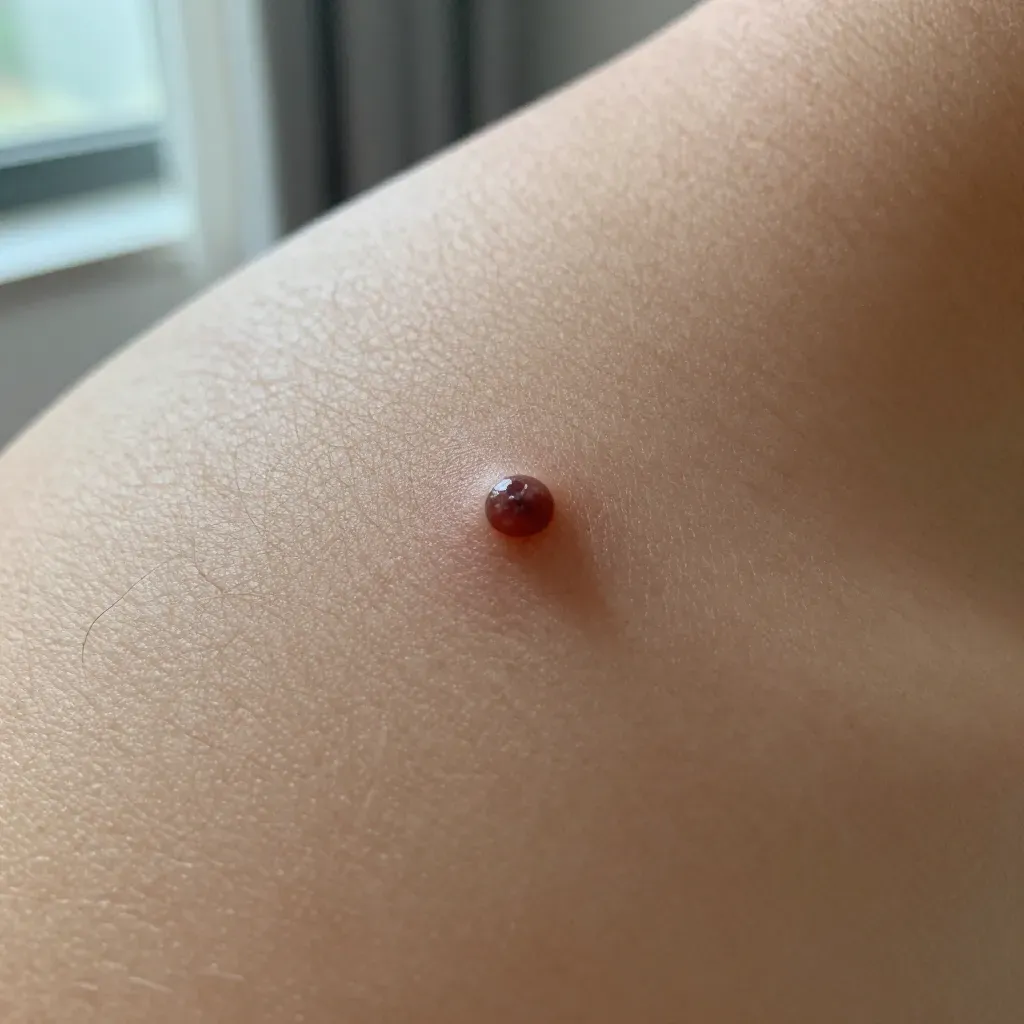
The cyst appears as a raised lump with a visible hair trapped underneath. Skin looks red or purple. Size ranges from 2-10mm in diameter. Multiple cysts may cluster together forming razor bump patterns.
Infection warning signs
Normal Cyst | Infected Cyst |
|---|---|
Mild redness | Rapidly spreading redness |
Slight tenderness | Intense throbbing pain |
No warmth | Skin feels hot to touch |
No discharge | Pus or yellow fluid present |
When to see a doctor immediately
- Cyst larger than 10mm or growing quickly
- Severe pain limiting movement or sleep
- Fever or feeling generally unwell
- Red streaks extending from the cyst
- Persistent cyst lasting more than 2 weeks
Recurring cysts need evaluation
Frequent ingrown hair cysts signal underlying issues. A dermatologist can assess hair growth patterns and prescribe long-term prevention strategies. Multiple cysts in beard area may require medical hair removal evaluation.
Home remedies include warm compresses and gentle exfoliation
Home treatment works for mild ingrown hair cysts without infection. Start immediately when you notice a small bump.
Core home treatment protocol
- Apply warm compress 3-4 times daily for 10-15 minutes
- Gently exfoliate once daily with soft washcloth or mild scrub
- Wash area twice daily with mild fragrance-free soap
- Never squeeze pick or attempt to pop the cyst
Over-the-counter options
Product | Purpose | Application |
|---|---|---|
Hydrocortisone cream 1% | Reduce inflammation | Thin layer 2-3x daily |
Salicylic acid 2% | Exfoliate trapped hair | Once daily |
Benzoyl peroxide 5% | Prevent infection | Once daily |
Antibiotic ointment | Protect broken skin | After warm compress |
Step-by-step daily routine
- Wash hands thoroughly
- Apply warm compress for 15 minutes
- Gently pat area dry
- Apply chosen OTC treatment
- Cover with clean bandage if needed
What never to do
- Do not use needles or tweezers to dig out hair
- Do not apply harsh chemicals like bleach
- Do not cover with occlusive plastic wrap
- Do not shave over or near the cyst
Natural alternatives
Tea tree oil diluted 1:10 with carrier oil reduces bacteria. Apply once daily. Apple cider vinegar diluted 1:1 with water helps exfoliate. Use once daily with cotton swab.
Medical treatments range from steroids to laser removal
Medical intervention becomes necessary when home remedies fail or infection develops. Doctors offer several treatment tiers based on severity.
First-line medical treatments
Doctors prescribe topical steroid creams to reduce inflammation within 3-5 days. Oral antibiotics treat active bacterial infections. Topical retinoids like tretinoin help shrink cysts and prevent future occurrences. For rapid relief, corticosteroid injections directly into the cyst reduce swelling within 24-48 hours. These medications target inflammation without invasive procedures.
Minor office procedures
Outpatient treatments resolve cysts in one visit. Incision and drainage uses a sterile blade to open the cyst and remove trapped hair and fluid. A sterile needle extraction carefully lifts the hair to the surface without damaging surrounding tissue. Both procedures take 10-15 minutes under local anesthesia and heal within one week with minimal scarring.
Advanced treatment options
Treatment | Best For | Recovery Time |
|---|---|---|
Laser hair removal | Chronic recurring cysts | Minimal downtime |
Oral isotretinoin | Severe widespread cases | 4-6 months treatment |
Electrosurgery | Individual stubborn cysts | 1-2 weeks healing |
Cryotherapy | Small surface cysts | 7-10 days |
When medical treatment is required
- Cyst persists beyond 2 weeks of home care
- Signs of infection appear
- Cyst larger than 10mm or extremely painful
- Recurrent cysts in same area
- Scarring or skin discoloration concerns
- Fever or spreading redness develops
Treatment costs and insurance
Insurance typically covers medically necessary treatments for infected or painful cysts. Cosmetic laser hair removal costs $200-500 per session. Minor procedures like incision and drainage average $100-300. Steroid injections range $50-150 per treatment. Most patients require 1-3 medical visits for complete resolution.
Prevent cysts with proper shaving and regular exfoliation
Correct technique prevents 90% of ingrown hair cysts.
Shaving method that works
- Shave with hair growth direction only
- Replace blades every 5-7 uses
- Apply thick shaving cream layer
- Stretch skin taut without pulling
- Rinse blade after each stroke
Exfoliation schedule by skin type
Skin Type | Frequency | Product |
|---|---|---|
Oily | Daily | Salicylic acid 2% |
Normal | Every other day | Glycolic acid 5% |
Dry/Sensitive | 2-3x weekly | Soft washcloth |
Take a break from hair removal
Stop all removal for 1-6 months if cysts recur. This allows skin to reset and heal inflammation completely.
Permanent prevention solutions
Laser hair removal reduces ingrown hairs by 90% after 6-8 sessions. At-home devices work for small areas. Professional treatment costs $200-500 per session but eliminates cysts permanently.
Daily skin care essentials
- Moisturize twice daily with fragrance-free lotion
- Wear loose cotton clothing over prone areas
- Wash after sweating with mild soap
- Never share razors
- Store razors dry to prevent bacteria
Product selection guidelines
Use non-comedogenic moisturizers. Avoid heavy oils that clog follicles. Test depilatory creams on small patch before full use.