
Table of Contents
Curly beard hair grows in spirals that puncture skin when shaved too close.
Close shaving leaves sharp tips below surface that act like needles.
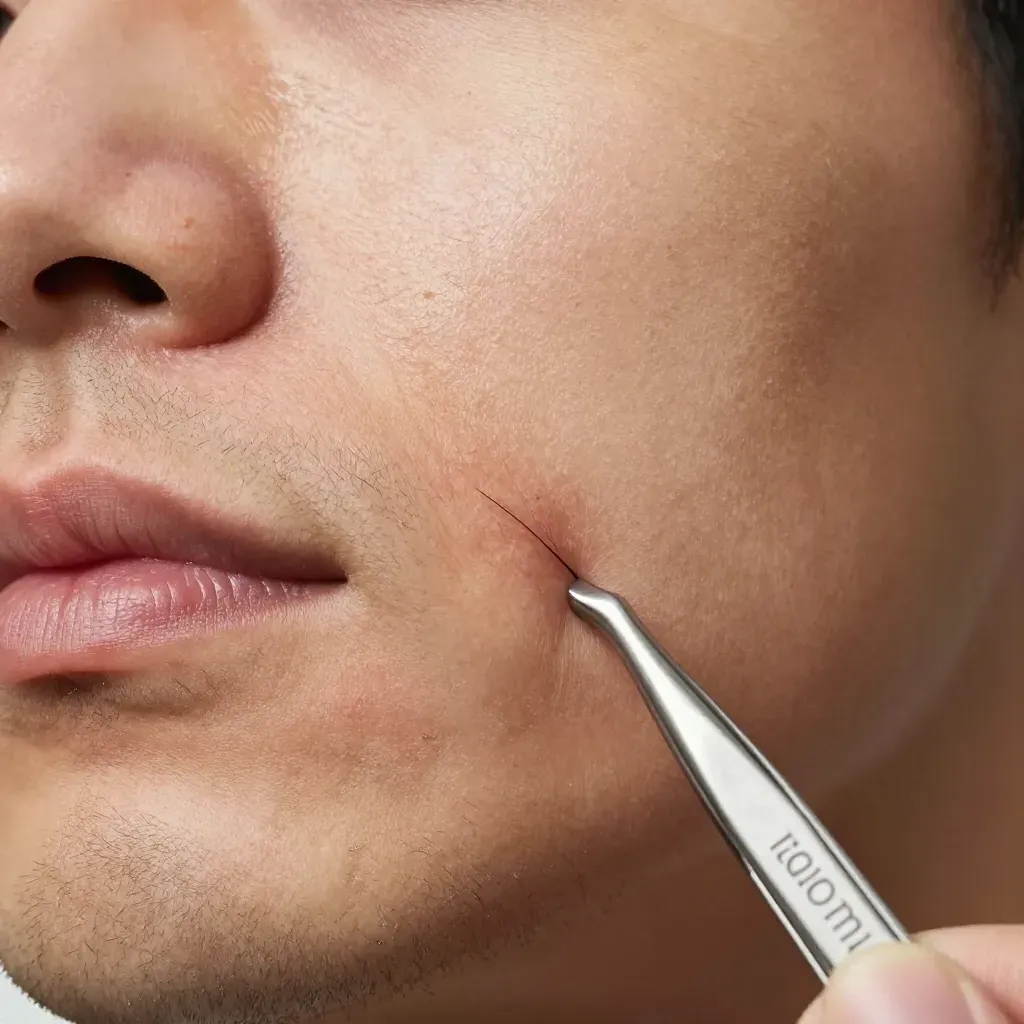
Treat with warm compresses 5-10 minutes, lift hair with sterile needle, pull with tweezers in growth direction.
Prevent by shaving with grain only, using sharp single-blade razors or electric trimmers, exfoliating 3-4 times weekly.
See doctor for spreading redness, pus, severe pain, or hair trapped after three days.
Sterilize tools by boiling or rubbing alcohol before each use.
Question | Answer |
|---|---|
Why does curly hair cause more ingrown beard hairs? | Spiral growth makes hair turn back into skin. |
How do I safely extract an ingrown beard hair? | Apply warm compress 5-10 minutes, lift hair with sterile needle, then pull with tweezers in growth direction. |
What prevents ingrown beard hairs best? | Shave with grain using sharp single-blade razors or electric trimmers and exfoliate 3-4 times weekly. |
When must I see a doctor? | See doctor for spreading redness, pus, severe pain, or hair trapped after three days. |
What tools are needed for home extraction? | Use sterile needle or tweezers, rubbing alcohol, and antiseptic cream. |
Close shaving curly hair causes ingrown beard hairs.
What causes ingrown beard hairs
Ingrown beard hairs form when sharp hair tips curl back into skin.
Shaving cuts hair at skin level leaving pointed ends.
Curly hair naturally grows in spirals instead of straight lines.
New growth punctures surrounding tissue instead of exiting follicle.
This creates raised red bumps that look like pimples.
Why curly hair is more prone
Curly hair texture forces growth into tight coils.
Coarse strands are thicker and pierce skin more easily.
Extra curliness increases chance of hair turning inward.
Thick hair follicles create more friction against surrounding skin.
Close shaving compounds the problem
Close cuts leave hair tips below skin surface.
Ultra-short hairs lack support to grow outward.
Multiple passes over same area create more irritation.
Dull blades tear hair creating jagged dangerous edges.
Shaving against grain cuts hair at sharper angle.
Risk Factor | Mechanism |
|---|---|
Curly hair | Spiral growth pattern turns inward |
Coarse texture | Thick strands easily pierce skin |
Close shaving | Cuts below surface creating sharp tips |
Dull razor | Tears hair leaving jagged edges |
Against grain | Creates sharper hair angle |
Multiple passes | Increases irritation and sharpness |
Sharp hair tips act like tiny needles piercing skin layers.
Skin responds with inflammation creating painful red bumps.
Apply warm compress then extract with sterile tools.
Warm compress technique
Soak clean washcloth in hot water. Wring out excess moisture. Press firmly onto ingrown hair bump. Hold for 5-10 minutes. Re-warm cloth as it cools. Repeat process 3-4 times before extraction. Heat opens pores and softens skin layers. Reduces painful swelling. Coaxes trapped hair toward surface where you can reach it safely. This preparation prevents skin damage during removal.
Sterile extraction steps
Wash hands thoroughly with antibacterial soap. Cleanse face with gentle wash. Sterilize needle or tweezers using rubbing alcohol. Allow tools to air dry completely. Locate hair loop or tip visible under skin surface. Slide needle edge under hair loop to lift gently upward. Use tweezers to grasp exposed hair shaft. Pull slowly in direction of natural growth. Remove entire coiled hair if possible. Apply antiseptic cream immediately after extraction to prevent infection.
Required tools list
- Sterile needle or precision tweezers
- Clean washcloth for compress
- Rubbing alcohol (70% or higher concentration)
- Antibacterial face wash
- Antiseptic ointment or cream
- Cotton pads for cleaning area
Critical extraction mistakes
Mistake | Result | Safe alternative |
|---|---|---|
Digging into skin with needle | Creates wounds, scars | Wait and reapply compress |
Pulling hair completely out | New sharp tip forms, repeats cycle | Guide out, trim length |
Using non-sterile tools | Introduces bacteria, infection | Always sterilize first |
Squeezing or popping bump | Pushes hair deeper, more inflammation | Hands off, use tools only |
Rushing extraction attempt | Hair breaks, increases irritation | Patience, multiple compresses |
When to stop and see doctor
Stop extraction attempt if you see no progress after 3-4 tries. If hair remains trapped deep below surface, wait 24 hours. Apply warm compresses twice daily during wait. See doctor immediately if you notice increasing redness, pus formation, or severe pain. Medical professionals use sterile blades to release stubborn ingrown hairs safely without scarring.
Prevent by shaving properly and exfoliating regularly.
Shave with the grain only
Shave in direction of hair growth every single stroke.
Use electric trimmer with guard to avoid cutting below skin level.
Sharp single-blade razors cut cleaner than multi-blade cartridges.
Apply thick shaving cream and let it sit for 30 seconds before shaving.
Limit yourself to one pass per area maximum.
Shave only once per week if you get ingrown hairs frequently.
Exfoliate beard area 3-4 times weekly
Physical exfoliation: Use soft bristle brush or scrub in circular motions.
Chemical exfoliation: Apply AHA/BHA serum after showering.
Focus extra attention on neck and jawline where hairs curl most aggressively.
Exfoliation removes dead skin cells that block hair follicle openings.
Consistent routine prevents buildup better than occasional intense sessions.
Essential prevention toolkit
- Sharp razor or electric trimmer with adjustable guard
- Beard brush with firm but flexible bristles
- AHA/BHA chemical exfoliant (salicylic acid or glycolic acid)
- Non-comedogenic beard oil or moisturizer
- Antibacterial face wash
- Clean towel dedicated for face only
Deadly shaving mistakes to avoid
Mistake | Mechanism | Fix |
|---|---|---|
Shaving against grain | Creates sharp angled tips that pierce skin | Always follow hair direction |
Multiple passes | Cuts hair below surface, increases irritation | One pass only, accept slight stubble |
Dull blades | Tears hair leaving jagged dangerous edges | Replace blade every 3-5 uses |
Dry shaving | No lubrication causes excess friction | Always use cream or oil |
Stretching skin taut | Forces hair below surface level | Keep skin relaxed |
Pressing too hard | Removes protective skin layer | Let razor weight do work |
Post-shave routine
Rinse thoroughly with cold water to close pores.
Pat dry with clean towel, never rub.
Apply beard oil immediately while skin still damp.
Avoid touching or scratching for 2-3 hours minimum.
Skip tight shirt collars that create friction on neck.
Wash pillowcases weekly to prevent bacterial buildup.
See doctor for infection or persistent cysts.
Infection warning signs
Spreading redness beyond bump edges signals infection.
Pus or yellow drainage means bacteria present.
Severe throbbing pain indicates deeper inflammation.
Fever or warmth around area requires immediate attention.
Multiple bumps merging into larger patch suggests spreading infection.
Swollen lymph nodes near jawline indicate systemic response.
Skin feels hot to touch compared to surrounding area.
Dark red or purple discoloration around bump.
When home treatment fails
Ingrown hair remains trapped after 3 days of warm compresses.
Bump grows larger despite careful extraction attempts.
Scar tissue forms over persistent ingrown hairs.
You get ingrown hairs weekly despite prevention efforts.
Cyst develops hard lump under skin surface.
Hair completely disappears under thick skin layer.
Whitehead forms but no hair visible for extraction.
Ingrown hair returns in same spot repeatedly.
Medical extraction procedures
Dermatologist uses sterile blade to release trapped hair.
Procedure takes 5-10 minutes in office.
Doctor may inject local anesthetic for deep cysts.
Small incision allows complete hair removal.
Stitches rarely needed for minor surgical release.
Healing occurs within 5-7 days post-procedure.
Cost ranges from $100-300 per extraction session.
Insurance may cover if infection present.
Prescription treatments
Treatment | Use Case | Duration |
|---|---|---|
Antibiotic ointment | Mild infection | 5-7 days |
Oral antibiotics | Spreading infection | 7-10 days |
Steroid cream | Inflammation | 3-5 days |
Retinoid cream | Dead skin prevention | 4-6 weeks |
Anti-inflammatory pills | Pain management | As needed |
Doctor visit checklist
Symptom | Action | Timeline |
|---|---|---|
Redness + pus | See doctor same day | Immediate |
Painful lump >1 week | Schedule appointment | Within 3 days |
Recurring ingrowns | Consult dermatologist | Within 1 week |
Scar formation | Discuss prevention plan | Preventive care |
No improvement after 3 days | Stop home treatment | Seek help |
Entire beard area affected | Request full assessment | Urgent |
Systemic symptoms (fever) | Go to urgent care | Same day |
Cost vs. benefit
Doctor visit costs $100-300 but prevents permanent scarring.
Prescription creams cost $20-50 but work faster than OTC products.
Professional extraction reduces risk of recurring ingrown hairs.
Insurance typically covers infected cases as medical necessity.
Multiple failed home attempts waste time and increase infection risk.
Use sterile tweezers and needles for extraction.
Sterilization process
Boil metal tools 10 minutes minimum.
Soak in 70% rubbing alcohol 5 minutes.
Pass through flame briefly for extra sterilization.
Cool completely before touching skin.
Use new alcohol swab between tools.
Never reuse without re-sterilizing.
Extraction technique
Locate hair loop under skin surface.
Slide needle edge parallel under hair.
Lift gently to expose hair tip.
Switch to tweezers when visible.
Grasp hair close to skin firmly.
Pull slowly in growth direction.
Stop if strong resistance or pain.
Tool selection guide
Tool | Best Use | Why |
|---|---|---|
Sharp needle | Deep embedded hairs | Slides under easily |
Pointed tweezers | Exposed hair tips | Precision grip |
Slanted tweezers | General removal | Broad surface |
Blackhead extractor | Never use | Pushes deeper |
Fingernails | Never use | Bacteria risk |
Common extraction errors
Error | Consequence | Correct Method |
|---|---|---|
Stabbing vertically | Puncture wound, scar | Slide parallel |
Digging motion | Skin damage, infection | One lift only |
Pulling upward | Hair breaks, stays trapped | Pull growth direction |
Excessive force | Skin tears, bleeding | Stop, wait |
Reusing tools | Cross-contamination | Re-sterilize |
Post-extraction care
Apply antiseptic immediately after removal.
Cover with bandage 2-3 hours.
Don't touch area 24 hours.
Continue warm compresses twice daily 2 days.
Watch for redness, swelling, pus.
Use clean pillowcase.