
Table of Contents
Ingrown pubic hair scars form when hair curls back into skin, triggering inflammation and irregular collagen healing that creates dark spots, raised tissue, or pitted marks.
Picking worsens damage and introduces infection, especially in the sensitive pubic area where friction and moisture increase risk.
Treat marks at home with gentle exfoliation using salicylic acid 2-3 times weekly and topical agents like retinoids, vitamin C, niacinamide, or silicone gel sheets for raised scars.
Professional treatments become necessary after 3-6 months of ineffective home care, with options including fractional laser for pitted scars, IPL for dark spots, microneedling for collagen rebuilding, and steroid injections for keloids.
Prevent future ingrown hairs by using single-blade razors, shaving with the grain, wearing loose cotton underwear, exfoliating regularly, and avoiding picking or tight clothing.
See a doctor immediately for spreading redness, pus, fever, or pain lasting over four weeks, as delays cause abscesses, permanent keloids, or bloodstream infections.
Question | Answer |
|---|---|
What causes ingrown pubic hair scars? | Hair curling back into skin causes inflammation; picking creates irregular collagen that forms scars. |
How can I fade dark marks at home? | Exfoliate with salicylic acid 2-3 times weekly and apply vitamin C, niacinamide, or retinoids to external skin. |
When should I see a dermatologist? | Seek help after 3-6 months of no improvement or for thick, raised, painful scars. |
What shaving method prevents ingrown hairs? | Use single-blade razors, shave with the grain, and replace blades every 5-7 shaves. |
What are infection warning signs? | Watch for spreading redness, pus, fever, hot skin, or pain lasting over four weeks. |
Understand what causes ingrown pubic hair scars and dark marks.
Ingrown pubic hair scars form when hair curls back into skin instead of growing out. This triggers inflammation and healing responses that leave marks.
How scars develop
Your body treats the trapped hair as a foreign object. White blood cells attack it. This creates swelling and redness. Picking or squeezing worsens damage. Infection can destroy deeper skin layers. All this leads to scar tissue formation. The more you manipulate the area, the worse the scarring becomes. Each time you dig at an ingrown hair, you create new micro-tears in the skin. These tears heal with irregular collagen patterns that show as scars.
Types of marks left behind
- Dark spots (post-inflammatory hyperpigmentation) - flat brown or black marks
- Raised scars (keloids or hypertrophic scars) - thick, elevated tissue
- Pitted scars (from severe infection) - small depressions in skin
- Persistent redness (post-inflammatory erythema) - lingering pink spots
Risk Factor | How It Causes Scars |
|---|---|
Curly or coarse hair | More likely to curl back into skin |
Tight clothing | Creates friction and traps hair |
Improper shaving | Creates sharp hair tips that easily re-enter skin |
Picking at bumps | Introduces bacteria and damages tissue |
Skin type | Darker skin produces more melanin when inflamed |
Dark marks happen when inflammation triggers melanin production. True scars form when collagen rebuilds unevenly. The pubic area is prone to both because skin is sensitive and friction is constant. Moisture and warmth create ideal conditions for inflammation. Shaving cuts hair at an angle, making sharp points that easily penetrate surrounding skin. Waxing can also cause trauma that leads to ingrown hairs. People with curly hair face higher risk because hair naturally curls back toward skin.
Try gentle exfoliation and topical treatments to fade scars at home.
Gentle exfoliation techniques
Exfoliation removes dead skin cells that trap dark marks. Use soft circular motions. Never scrub aggressively. Physical options include sugar scrubs mixed with coconut oil or a soft washcloth. Chemical exfoliants work deeper. Salicylic acid (BHA) penetrates hair follicles and clears debris. Glycolic acid (AHA) dissolves surface dead skin. Start with 5% concentration. Apply only to external skin, never mucous membranes. Exfoliate 2-3 times weekly max. Over-exfoliation creates more inflammation and worsens scarring.
Topical treatments that fade scars
- Retinoids: Speed up cell turnover. Use adapalene 0.1% gel every other night. Pea-sized amount only. Causes dryness initially.
- Vitamin C serum: Brightens hyperpigmentation. Apply 10-20% L-ascorbic acid daily. Helps collagen rebuild properly.
- Silicone gel sheets: Flatten raised scars. Wear 12 hours daily for 2-3 months. Creates healing environment.
- Hydroquinone 2%: Lightens dark spots. Use for maximum 3 months. Avoid on broken skin.
- Niacinamide 5%: Reduces inflammation and pigmentation. Safe for daily use on sensitive areas.
Treatment | How Often | Key Tip |
|---|---|---|
Salicylic acid | 2-3x/week | Apply after shower |
Retinoid | Every other night | Moisturize after |
Vitamin C | Every morning | Use sunscreen |
Silicone sheet | 12 hrs daily | Wash and reuse |
Niacinamide | Twice daily | Layer under moisturizer |
Safe application for pubic area
Cleanse with mild soap first. Pat completely dry. Apply treatments only to external skin where hair grows. Avoid inner labia or penile shaft. Do a patch test on your inner thigh for 48 hours. Stop if you feel burning or see increased redness. Always follow with fragrance-free moisturizer. Wear loose cotton underwear to reduce friction. Results take 6-12 weeks of consistent use. Dark marks fade first. Raised scars need longer treatment.
Consider professional dermatological treatments for stubborn scars.
When home treatments fail
Professional help becomes necessary after 3-6 months of consistent home care with no improvement. Deep pitted scars, thick keloids, and persistent dark spots resist over-the-counter products. Dermatologists assess scar type and skin tone to customize treatments. Darker skin requires specialized approaches to avoid further pigmentation issues.
Laser therapy options
Fractional laser resurfacing creates microscopic wounds that trigger collagen remodeling. This smooths pitted scars and evens texture. Most patients need 3-5 sessions spaced 4-6 weeks apart. Each session costs $300-800 depending on treatment area size.
Intense Pulsed Light (IPL) targets melanin in dark spots. It breaks up pigment clusters without damaging surrounding skin. Best for flat hyperpigmentation. Requires 4-6 sessions. Not suitable for very dark skin tones due to burn risk.
Non-ablative lasers heat deeper skin layers while leaving surface intact. This stimulates collagen with minimal downtime. Good for raised scars and texture issues. Results appear gradually over several months.
Other effective procedures
- Chemical peels: TCA peels remove top skin layers where dark pigment lives. Medium-depth peels work best for pubic area scars. 2-3 treatments needed. Costs $150-400 per session.
- Microneedling: Tiny needles create controlled injuries that rebuild collagen. Safe for all skin tones. Requires 4-6 sessions. Each session runs $200-500.
- Steroid injections: Directly into raised keloids. Flattens thick scar tissue. May need repeat injections every 4-6 weeks. Costs $100-300 per injection.
- Subcision: Needle breaks scar tissue tethering pitted scars to deeper layers. Allows skin to rise and smooth out. Often combined with fillers. One-time procedure costing $500-1000.
Treatment | Best For | Sessions | Downtime |
|---|---|---|---|
Fractional laser | Pitted/textured scars | 3-5 | 3-7 days redness |
IPL | Dark spots | 4-6 | 1-2 days |
TCA peel | Hyperpigmentation | 2-3 | 5-7 days peeling |
Microneedling | All scar types | 4-6 | 1-2 days redness |
Steroid injection | Raised scars | 2-4 | None |
Preparing for treatment
Stop all retinoids and exfoliants one week before any procedure. Avoid sun exposure for two weeks prior. Shave the area 24 hours before treatment day. Wear loose clothing to appointment. Results take 3-6 months to fully appear as collagen rebuilds. Maintenance treatments may be needed annually.
Prevent future ingrown hairs and scars with proper grooming habits.
Shaving techniques that prevent ingrown hairs
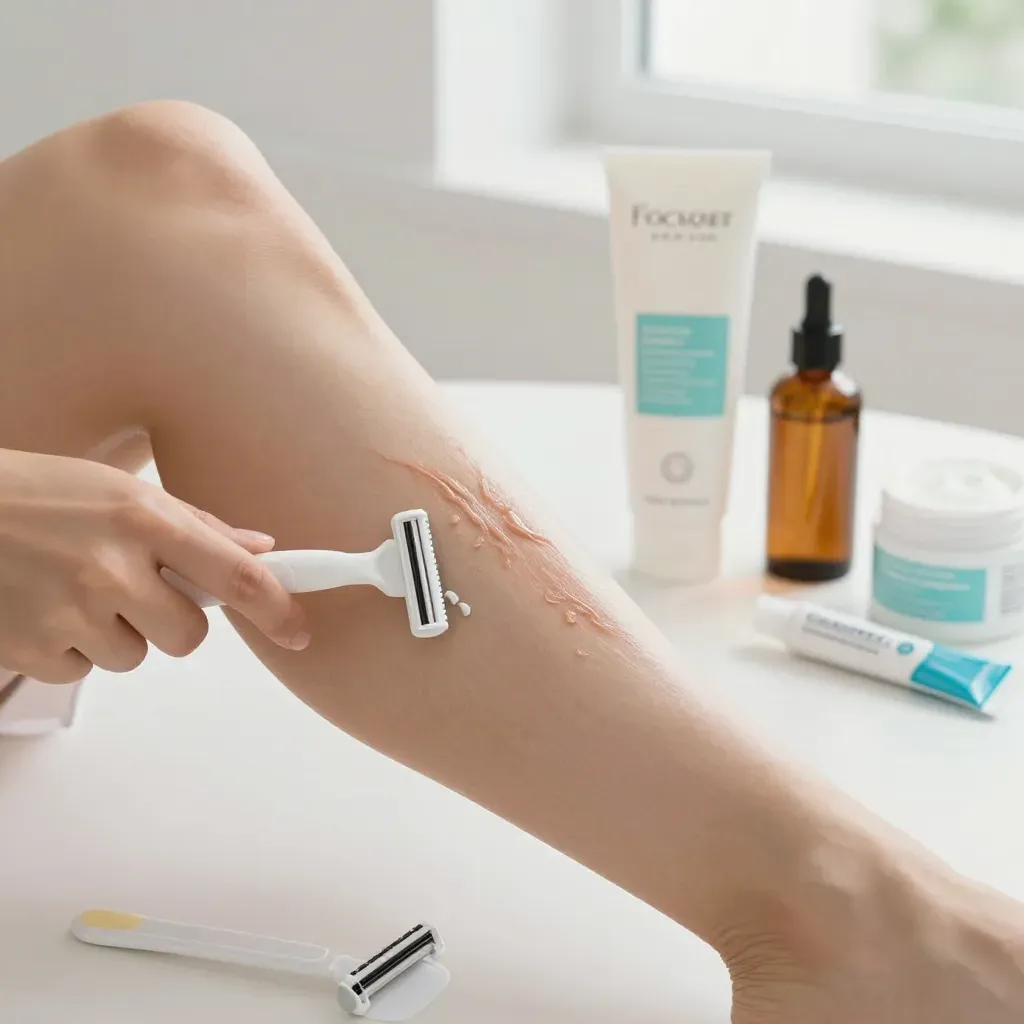
Use a single-blade razor. Multi-blade razors cut hair below skin level, increasing ingrown risk. Shave with the grain (hair growth direction) only. Stretch skin taut while shaving. Rinse blade after each stroke. Replace blades every 5-7 shaves. Use shaving cream with glycerin or aloe. Avoid soap—it dries skin and clogs pores. Shave at end of shower when hair is softest.
Better hair removal alternatives
Laser hair removal permanently reduces hair growth. Requires 6-8 sessions. Costs $200-400 per session. Eliminates ingrown hairs completely. Works best on dark hair, light skin. Depilatory creams dissolve hair at skin surface. No sharp tips left behind. Choose formulas for sensitive areas. Do patch test 48 hours before. Use once every 2 weeks. Trimming with scissors leaves hair above skin. Zero ingrown risk. Maintains neat appearance. Do weekly.
Daily prevention habits
Exfoliate 2-3 times weekly with salicylic acid. Keeps follicles clear. Moisturize daily with fragrance-free lotion. Prevents dry skin that traps hair. Wear loose cotton underwear. Reduces friction and irritation. Shower after sweating. Removes bacteria and dead skin. Change razor blades regularly. Dull blades cause tugging and uneven cuts.
Habit | Frequency | Benefit |
|---|---|---|
Exfoliate | 2-3x/week | Clears dead skin |
Moisturize | Daily | Softens skin |
Change razor | Every 5-7 shaves | Prevents tugging |
Wear loose underwear | Daily | Reduces friction |
What to avoid
Never pick at bumps. This introduces bacteria and creates scars. Avoid tight synthetic underwear. Traps moisture and creates friction. Don't dry shave. Causes micro-cuts and irritation. Skip heavy lotions with fragrances. Clogs pores and causes inflammation. Don't share razors. Spreads bacteria and infections.
Know when to see a doctor for infected or persistent ingrown hairs.
Warning signs of infection
- Pain that worsens instead of improves
- Redness spreading beyond the bump
- Skin feels hot to touch
- Yellow or green pus drains from the area
- Fever or chills develop
- Swollen lymph nodes in groin area
- Red streaks radiating from the bump
When to seek professional help
See a doctor if the ingrown hair lasts more than 4 weeks. Recurring ingrown hairs in the same spot need evaluation. Multiple painful bumps cluster together. Home treatments fail after 6-8 weeks of consistent use. Scars become thick, raised, or painful. You have diabetes or immune system issues. Any sign of infection requires immediate medical attention.
Medical treatments available
Treatment | Purpose | Recovery |
|---|---|---|
Oral antibiotics | Treat bacterial infection | 5-7 days |
Incision and drainage | Remove pus from abscess | 3-5 days |
Steroid injection | Reduce inflammation | 1-2 days |
Professional extraction | Remove trapped hair | Same day |
Culture test | Identify bacteria type | 2-3 days wait |
What happens if you wait
Delaying treatment allows infection to spread deeper into skin layers. Abscesses form requiring surgical drainage. Permanent keloid scars develop. Infection can enter bloodstream causing sepsis. Chronic folliculitis creates ongoing cycle of bumps. Hair follicles become permanently damaged. Dark spots become more stubborn and harder to fade.
Preparing for your appointment
Stop all home treatments 48 hours before visit. List all products you have tried. Note when ingrown hair first appeared. Take photos of progression. Write down any symptoms you have experienced. Be ready to discuss your hair removal methods. Bring list of current medications. This helps doctor determine best treatment plan quickly.