
Table of Contents
Ingrown beard hairs happen when shaved hair regrows and pierces skin. Curly hair and close shaving cause red bumps and pustules. Treat mild cases with warm compresses and sterile needles. Laser removal eliminates follicles after 6-8 sessions. Prevent by shaving with the grain and exfoliating. See doctors for infected cysts or chronic issues.
Question | Answer |
|---|---|
What causes ingrown beard hairs? | Curly hair and close shaving cut hair at sharp angles that pierce skin during regrowth. |
How do you treat mild ingrown beard hairs at home? | Apply warm compresses for 15 minutes twice daily, then lift visible hair loops with a sterile needle. |
When should you seek medical treatment? | See a doctor for pus, severe redness, fever, or painful lumps larger than 1cm. |
Does laser hair removal permanently stop ingrown beard hairs? | Yes, laser destroys follicles after 6-8 sessions, preventing 80-90% of ingrown hairs. |
How can you prevent ingrown beard hairs? | Shave with the grain using sharp blades replaced every 3-5 shaves and exfoliate 2-3 times weekly. |
Ingrown beard hairs occur when facial hair curls back into skin instead of growing outward.
Ingrown beard hairs develop when shaved facial hair regrows at an angle and pierces surrounding skin. Shaving cuts hair at an angle, creating sharp tips that easily re-enter the skin surface during regrowth. This condition primarily affects men with curly or coarse beard hair.
Primary causes in beard area
- Hair texture: Curly and coarse beard hair naturally curves back toward skin
- Close shaving: Cuts hair below surface, forcing it to grow sideways under skin
- Dead skin buildup: Clogged follicles trap emerging hairs beneath surface
- Shaving direction: Against-the-grain shaving pulls follicles incorrectly
- Dull razors: Tug hair instead of cutting cleanly
Identification symptoms
Symptom | Appearance |
|---|---|
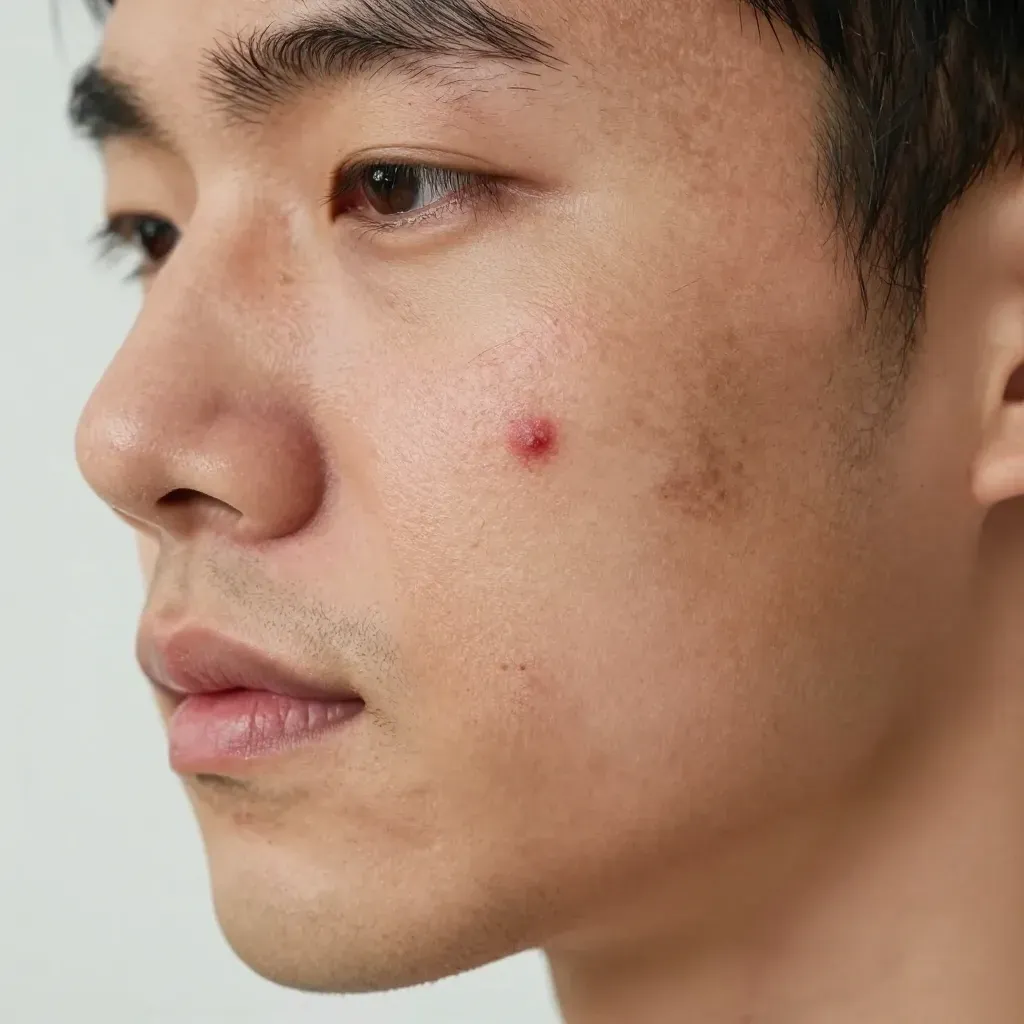
Red bumps | Small inflamed papules along jawline and neck |
Tenderness | Painful to touch, especially during shaving |
Pustules | White-headed bumps indicating mild infection |
Itching | Persistent irritation in affected areas |
Dark spots | Post-inflammatory hyperpigmentation |
Men who shave frequently face higher risk. The condition creates painful bumps that can develop into infected cysts without proper treatment. Ingrown beard hairs commonly appear on the neck and jawline where hair grows in multiple directions.
Warm compresses and sterile needles provide safe at-home removal for visible ingrown hairs.
Visible ingrown beard hairs respond well to simple home treatments when done correctly. Warm compresses soften skin and open pores, making hair release easier. This method works best for mild cases with visible hair loops near the surface. Never attempt extraction on deep, painful cysts.
Proper warm compress technique
- Apply warm (not hot) compress for 15 minutes
- Repeat twice daily for 2-3 consecutive days
- Use clean washcloth soaked in warm water
- Gentle circular motions help lift trapped hair
- Pat dry gently—do not rub irritated skin
- Moisturize after treatment with non-comedogenic lotion
Sterile needle extraction protocol
After compress treatment, sterilize a needle with alcohol. Gently lift the hair tip out without digging under skin. Never pluck completely—allow hair to grow above skin surface. Work in good lighting with a magnifying mirror.
Step | Action | Duration | Warning Signs |
|---|---|---|---|
1 | Disinfect area with alcohol pad | 30 seconds | Burning sensation indicates broken skin |
2 | Apply warm compress for 15 min | 15 minutes | Too hot causes burns |
3 | Locate visible hair loop | 1-2 minutes | Stop if hair not visible |
4 | Gently lift tip with sterile needle | 1 minute | Bleeding means stop immediately |
5 | Apply antibiotic ointment | 30 seconds | Cover with clean bandage |
Aftercare and prevention integration
- Keep area clean and dry for 24 hours post-extraction
- Continue warm compress daily for 3 days to reduce inflammation
- Use sharp razor blades to prevent recurrence
- Replace blades every 3-5 shaves maximum
- Avoid shaving over treated areas until fully healed
- Exfoliate gently 2-3 times weekly to prevent dead skin buildup
- Apply salicylic acid toner to keep follicles clear
Multiple failed attempts mean the hair sits too deep. Continuing can cause scarring and infection. Professional dermatologists use sterile instruments and proper lighting for safe extraction. They can also prescribe antibiotics if infection develops. Consider laser hair removal for chronic recurring ingrown beard hairs.
Laser hair removal offers permanent solution by destroying follicles that cause recurring ingrown beard hairs.
Laser hair removal destroys follicles that cause ingrown beard hairs permanently.
The laser emits concentrated light that melanin in hair absorbs, converting to heat which damages the follicle.
Damaged follicles cannot produce new hair, eliminating ingrown hair formation at the source.
How laser targets follicles
Treatment works during active growth phase (anagen) when hair connects directly to follicle.
Only 20-30% of beard hairs are in anagen phase at any given time.
Multiple sessions ensure all follicles get treated as they enter growth phase.
Laser does not affect dormant follicles.
Treatment schedule for beard area
Facial hair cycles faster than body hair.
Beard treatments require sessions every four weeks.
Most men need 6-8 sessions for permanent reduction.
Annual maintenance sessions may be needed for residual hair.
Beard Area | Session Interval | Total Sessions | Maintenance |
|---|---|---|---|
Full beard | 4 weeks | 6-8 | 1/year |
Neck only | 4 weeks | 4-6 | 1/year |
Spot treatment | 4 weeks | 3-5 | As needed |
Benefits over traditional methods
- Permanent reduction of ingrown hairs by 80-90%
- Eliminates daily shaving requirements
- Reduces skin irritation and inflammation
- Prevents scarring and hyperpigmentation
- Treats entire beard area including problematic neck region
- Saves time and money long-term
Cost vs benefit analysis
Initial investment ranges $200-400 per session.
Total treatment costs $1,200-3,200 depending on beard density.
Compare to lifetime cost of shaving products, ingrown hair treatments, and dermatologist visits.
Most men recover costs within 2-3 years.
Candidates and considerations
Best results occur with dark hair and light skin contrast.
Newer laser technologies safely treat darker skin tones.
Avoid sun exposure for two weeks pre-treatment.
Temporary side effects include redness and swelling for 24-48 hours.
Visible results appear after 2-3 sessions, with full results after completing the treatment series.
Proper shaving techniques and exfoliation prevent future ingrown beard hair formation.
Prevention requires proper technique and consistent exfoliation. These methods keep hair growing outward instead of curling back into skin.
Shaving technique fundamentals
- Shave with the grain, never against it
- Use sharp blades—replace every 3-5 shaves maximum
- Apply minimal pressure; let razor weight cut hair
- Rinse blade after each stroke to prevent clogging
- Limit passes to one or two across each area
- Avoid stretching skin taut during shaving
Exfoliation routine
Frequency | Method | Purpose |
|---|---|---|
Daily | Washcloth circular motions | Removes dead skin blocking follicles |
2-3x/week | Salicylic acid 2% | Dissolves oil and dead cells |
1x/week | Gentle physical scrub | Prevents buildup on skin surface |
Pre-shave | Warm compress 5-10 min | Softens hair and opens pores |
Pre-shave preparation
- Wash with non-comedogenic cleanser
- Apply warm compress for 5 minutes
- Use pre-shave oil on coarse areas
- Lather with quality shaving cream
- Let cream sit 2 minutes to soften hair
Alternative: Clippers
Electric clippers cut hair above skin surface, preventing ingrowth entirely. Set to 1-2mm length. Use clippers on neck areas where hair grows in multiple directions. This method eliminates close shaving while maintaining groomed appearance.
Post-shave protocol
- Rinse with cool water to close pores
- Apply alcohol-free aftershave balm
- Use non-comedogenic moisturizer
- Skip shaving over bumps until healed
- Resume shaving every 2-3 days minimum
Seek medical treatment for infected cysts or chronic ingrown beard hair problems.
Infected ingrown beard hairs require professional intervention. Home extraction fails when deep cysts form or infection spreads. Dermatologists provide sterile procedures and prescription treatments.
Signs of infection
Warning Sign | Action Required |
|---|---|
Pus or yellow drainage | Antibiotics needed |
Severe redness spreading | See doctor within 24 hours |
Fever or chills | Emergency care |
Painful lump >1cm | Professional drainage |
Multiple bumps | Chronic condition evaluation |
Professional treatment options
- Incision and drainage: Sterile removal of infected cyst contents
- Corticosteroid injections: Reduce inflammation and swelling
- Oral antibiotics: Treat bacterial infections
- Topical retinoids: Prevent follicle clogging
- Professional extraction: Sterile needle removal under magnification
- Laser hair removal: Permanent follicle destruction
- Electrolysis: Individual follicle removal for small areas
When to schedule dermatologist appointment
- Ingrown hairs persist despite proper shaving technique for 3+ months
- Scarring or dark spots develop in beard area
- Recurrent cysts form in same locations
- Quality of life affected by constant irritation
- Over-the-counter treatments fail after 6-8 weeks
Prescription prevention options
Dermatologists may prescribe topical antibiotics like clindamycin for daily use. Retinoid creams increase cell turnover, preventing dead skin buildup. Eflornithine cream slows facial hair growth, reducing shaving frequency. These treatments work alongside proper shaving techniques.
Cost considerations
Insurance often covers treatment when ingrown hairs cause infection or scarring. Document symptoms with photos. Get referral from primary care physician. Out-of-pocket dermatologist visits cost $150-300. Laser hair removal for beards costs $1,200-3,200 total but eliminates recurring costs of shaving products and medical treatments.