
Table of Contents
Ingrown facial hair cysts form when shaved or plucked hairs grow back into skin.
Apply warm compresses 10-15 minutes, 3-4 times daily to bring hair to the surface.
Lift visible hairs gently with a sterile needle—never squeeze cysts.
See a doctor for large cysts, severe pain, infection, or no improvement after 3-4 days.
Medical treatments include antibiotics, retinoid creams, steroid injections, or surgical drainage.
Prevent cysts by shaving with the grain, exfoliating 2-3 times weekly, and using sharp single-blade razors.
Question | Answer |
|---|---|
What causes ingrown facial hair cysts? | Shaving or plucking makes hairs grow back into skin. |
How do you treat them at home? | Use warm compresses to bring hair to the surface, then lift with a sterile needle. |
When should you see a doctor? | See a doctor for large cysts, severe pain, infection, or no improvement after 3-4 days. |
What medical treatments work? | Doctors use antibiotics, retinoid creams, steroid injections, or surgical drainage. |
How can you prevent them? | Shave with the grain, exfoliate regularly, and use sharp single-blade razors. |
Ingrown facial hair cysts form when hairs curl back into skin after shaving or plucking.
Effective ingrown facial hair cyst removal begins by knowing the cause.
An ingrown hair occurs when a hair shaft curls and grows back into the skin.
It can also grow sideways into the hair follicle wall.
This often happens after hair removal like shaving or tweezing.
When you shave, the cut hair gets a sharp edge.
This sharp tip can easily pierce the skin as it grows back.
Dead skin cells can also clog the hair follicle opening.
This blockage forces the hair to grow under the skin.
Your body treats the trapped hair like a foreign object.
This triggers an inflammatory response, creating a red, swollen bump called a papule.
If it fills with pus, it becomes a pustule.
When this inflammation goes deep, it forms a larger, harder, painful lump known as an ingrown hair cyst.
Common Causes and Risk Factors
Hair removal is the main cause of ingrown facial hair.
- Shaving: Pulling the skin taut for a close shave increases risk. The cut hair retracts below the skin surface.
- Tweezing: Plucking can break the hair, leaving a fragment behind to grow inward.
- Hair Type: People with coarse or curly hair are more susceptible. The natural curl encourages the hair to re-enter the skin.
These bumps are often called "razor bumps" or pseudofolliculitis barbae.
They are very common in the male beard area and on the neck.
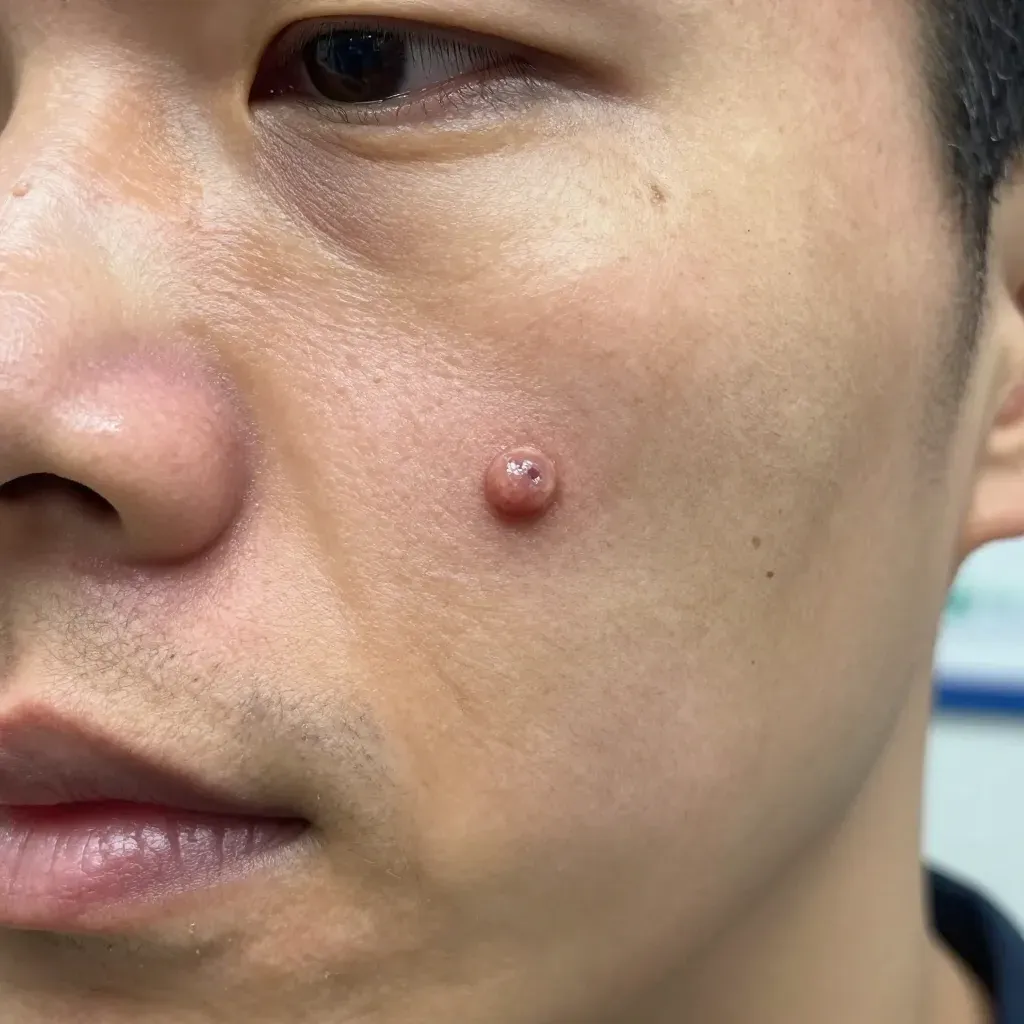
An ingrown hair cyst looks like a small boil or cystic acne.
You might see a dark spot under the skin, which is the trapped hair.
Do not squeeze these cysts.
Squeezing worsens inflammation, risks infection, and can cause permanent scarring.
Treat at home with warm compresses and a sterile needle to lift the trapped hair.
Home treatment works for small, uninfected ingrown facial hair cysts.
Apply warm compresses
Soak a clean washcloth in hot water—not scalding.
Apply it to the cyst for 10-15 minutes, 3-4 times daily.
The heat softens skin and brings the trapped hair closer to the surface.
Repeat this process for 1-3 days until you see the hair loop emerge.
Do not attempt extraction until the hair is visible.
Use a sterile needle
Only proceed when you can clearly see the hair above the skin.
Sterilize a fine-tipped needle with rubbing alcohol for 30 seconds.
Let it air dry completely before use.
Gently insert the needle tip under the hair loop.
Lift the hair upward—do not dig, poke deep, or break the skin.
Use clean tweezers to grasp and pull the free end out completely.
Do | Don't |
|---|---|
Wait for hair to surface | Dig into deep cysts |
Use sterile tools | Reuse needles |
Lift gently | Squeeze or pop |
Aftercare steps
Wash the area with mild soap and water immediately after removal.
Apply a thin layer of over-the-counter antibiotic ointment like bacitracin or polysporin.
Leave the wound open to air—avoid tight bandages on the face.
Continue warm compresses for another day to reduce residual swelling.
Avoid shaving over the spot until fully healed.
Stop and seek medical help if
- Pain increases sharply instead of improving
- Redness spreads beyond the bump or forms streaks
- Pus drains from the site
- You develop fever or feel unwell
- The cyst remains after 3-4 days of consistent treatment
Never squeeze or pop the cyst—this drives bacteria deeper and causes scarring.
Never reuse needles or share tweezers between people.
Deep or recurrent cysts need professional removal to prevent infection.
See a doctor if the cyst grows large, becomes painful, or shows infection signs.
Some ingrown facial hair cysts need professional treatment.
Warning signs that need medical care
Sign | What it means |
|---|---|
Cyst larger than 1 cm | Deep inflammation, may need drainage |
Severe, throbbing pain | Pressure buildup and possible abscess |
Red streaks spreading outward | Infection moving into bloodstream |
Fever, chills, fatigue | Systemic infection |
Pus, foul odor, warmth | Active bacterial infection |
No improvement after 4 days | Cyst too deep for home treatment |
Medical treatments doctors provide
Doctors treat persistent cysts with prescription medications and minor procedures.
- Oral antibiotics: Doxycycline or clindamycin stop bacterial infection spread.
- Topical retinoids: Tretinoin or adapalene creams unclog follicles and reduce inflammation.
- Steroid injections: Triamcinolone injected directly into the cyst reduces swelling quickly.
- Incision and drainage: Doctor makes a small cut, drains pus, removes the trapped hair.
- Complete surgical excision: Removes the entire cyst sac to prevent recurrence.
Why professional removal matters
Facial skin is delicate and highly visible.
Improper removal causes scarring, hyperpigmentation, and keloid formation.
Deep cysts often hide multiple hair fragments that only a dermatologist can locate.
Doctors use sterile techniques that prevent infection and minimize tissue damage.
Recurrent cysts may signal underlying folliculitis or pseudofolliculitis barbae.
These conditions need long-term management plans, including laser hair removal.
What to expect at the appointment
The doctor examines the cyst under magnification.
They may swab the area to identify bacteria.
Local anesthetic numbs the area before any procedure.
Most procedures take 15-30 minutes.
You leave with aftercare instructions and prescription medications if needed.
Follow-up appointments ensure proper healing and prevent recurrence.
Doctors treat persistent cysts with antibiotics, retinoid creams, and surgical drainage.
Medical treatments target infection, inflammation, and trapped hair.
Antibiotic therapy
Doctors prescribe oral antibiotics for infected cysts.
Doxycycline and clindamycin are common choices.
These drugs kill bacteria and reduce inflammation.
Treatment lasts 7-10 days.
Topical antibiotic ointments like mupirocin work for mild cases.
Finish the full course even if symptoms improve.
Retinoid creams
Topical retinoids like tretinoin and adapalene unclog hair follicles.
They speed up skin cell turnover.
This prevents dead skin from trapping hairs.
Apply a pea-sized amount nightly to affected areas.
Expect dryness and peeling at first.
Results appear after 4-6 weeks of consistent use.
Retinoids also reduce scarring risk.
Surgical drainage and removal
For large or painful cysts, doctors perform minor surgery.
They inject local anesthetic to numb the area.
Then make a small incision over the cyst.
They drain pus and extract the trapped hair.
For recurrent cysts, they remove the entire cyst sac.
This prevents regrowth.
The procedure takes 15-30 minutes.
You get aftercare instructions and return for suture removal if needed.
Steroid injections
Corticosteroid injections reduce swelling quickly.
Triamcinolone injected directly into the cyst shrinks inflammation within 24-48 hours.
This works well for cysts without infection.
Doctors may combine steroids with antibiotics.
Treatment comparison
Treatment | Best for | Recovery time |
|---|---|---|
Oral antibiotics | Infected cysts | 7-10 days |
Retinoid creams | Prevention, mild cases | 4-6 weeks |
Steroid injection | Inflamed, non-infected cysts | 1-2 days |
Incision & drainage | Large, painful cysts | 5-7 days |
Surgical excision | Recurrent cysts | 1-2 weeks |
Follow doctor instructions exactly.
Don't pick at treated areas.
Keep follow-up appointments to monitor healing and prevent new cysts.
Prevent future cysts by shaving with the grain and exfoliating regularly.
Prevention stops ingrown hairs before they become cysts.
Shave correctly
Shave in the direction of hair growth—called "with the grain."
This leaves the hair tip pointing outward, not stabbing back into skin.
Use a sharp, single-blade razor.
Multi-blade razors cut too close and increase ingrown risk.
Don't pull skin taut while shaving.
Let the razor glide lightly—don't press hard.
Rinse the blade after each stroke.
Exfoliate regularly
Exfoliation removes dead skin cells that clog follicles.
Use a gentle facial scrub 2-3 times per week.
Or apply a chemical exfoliant containing salicylic acid or glycolic acid daily.
These acids dissolve dead skin and keep pores clear.
Start with low concentrations to avoid irritation.
Other key prevention steps
Do | Don't |
|---|---|
Use shaving cream or gel | Dry shave |
Moisturize after shaving | Use alcohol-based aftershave |
Replace razor blades often | Reuse dull blades |
Consider electric razors | Shave against the grain |
Consider laser hair removal for permanent reduction.
Laser destroys the follicle, preventing future ingrowth.
Multiple sessions are needed for best results.
Keep skin clean with a mild cleanser twice daily.
Avoid heavy, oily moisturizers that clog pores.
Wear loose collars to reduce friction on neck and jawline.
Friction pushes hair tips back into skin.
Establish a consistent routine.
Prevention requires daily effort but eliminates painful cysts.