
Table of Contents
Ingrown hair removal surgery becomes necessary when home treatments fail and infection sets in. Warning signs include persistent pain spreading redness pus deep lumps and no improvement after two weeks. Doctors perform minor in-office procedures like incision and drainage complete excision or wedge excision using local anesthesia. Costs range from 50 to 150-plus dollars depending on severity and technique. Recovery takes 1 to 2 weeks with proper wound care. Laser hair removal offers a long-term preventive solution by destroying follicles so hair cannot regrow and curl back under the skin.
Question | Answer |
|---|---|
When does an ingrown hair require surgery? | Surgery is needed when pain worsens over days, pus develops, a hard lump forms deep under the skin, or home treatment shows no improvement after 1 to 2 weeks. |
How long does the surgical extraction procedure take? | The procedure takes 15 to 30 minutes and uses local anesthesia so you feel no pain during extraction. |
How much does ingrown hair removal surgery cost? | Simple extraction costs 50 to 100 dollars while complex cyst removal or wedge excision ranges from 100 to over 150 dollars. |
What is the recovery time after surgical extraction? | Most incisions heal completely within 7 to 14 days with proper wound care including gentle cleaning and avoiding friction or sweating. |
Can laser hair removal prevent future ingrown hairs? | Yes, laser destroys the hair follicle so hair cannot regrow and curl under the skin, offering 70 to 90 percent permanent reduction with professional treatment. |
Identify the specific signs that indicate you need surgical intervention.
Most ingrown hairs clear up on their own within a few weeks. Surgery becomes necessary when the condition progresses beyond what home care can handle. Look for these warning signs.
- Persistent pain that worsens over days not weeks
- Redness and swelling spreading beyond the original bump
- Pus or thick discharge from the area
- A hard lump forming deep under the skin
- No improvement after 1 to 2 weeks of home treatment
- The hair is completely invisible beneath the skin surface
- A bump that keeps growing in size
Infection vs. Normal Healing
Knowing the difference prevents delayed treatment. Compare the symptoms below.
Normal Ingrown Hair | Infected Ingrown Hair |
|---|---|
Mild tenderness | Intense throbbing pain |
Small red bump | Large swollen area with heat |
Improves in 3 to 5 days | Worsens after a week |
No discharge or minimal clear fluid | Thick yellow or green pus |
Localized to one spot | Spreading redness around the bump |
When an Abscess Forms
An abscess is a pocket of infection beneath the skin. This is the most critical sign that surgical removal is needed. The area feels hot to the touch and fills with infected fluid that cannot drain on its own. A dermatologist must perform incision and drainage to release the trapped pus and remove the embedded hair follicle.
Type 2 and Type 3 ingrown hairs carry the highest risk for these complications. These types grow deep beneath the skin surface and form dense cyst-like structures that home extraction cannot resolve. If you have recurrent cysts in the same area a doctor may recommend wedge excision to remove the entire problematic follicle and prevent return.
Learn how doctors perform the surgical extraction procedure.
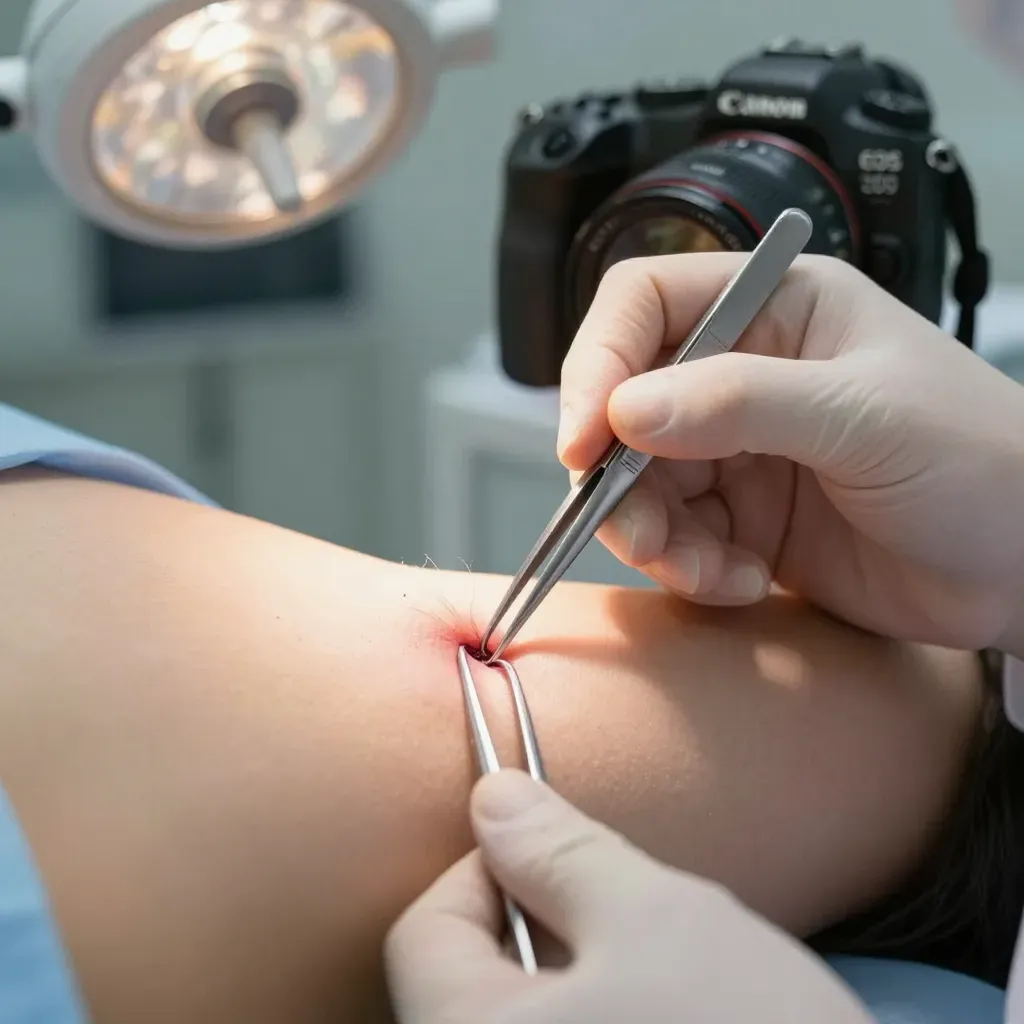
Doctors perform ingrown hair extraction as a minor in-office procedure. The entire process usually takes 15 to 30 minutes depending on complexity.
Step-by-Step Procedure
Step | What Happens |
|---|---|
1. Site Preparation | Skin cleaned and sterilized to prevent infection |
2. Local Anesthesia | Numbing agent injected into the specific area |
3. Incision | Small precise cut made to access the trapped hair |
4. Extraction | Hair released and removed with sterile instruments |
5. Wound Closure | Incision closed with absorbable sutures or steri-strips |
Four Main Surgical Techniques
Doctors choose the method based on severity and whether infection is present.
- Incision and Drainage - Used for acute infections. Doctor drains infected material then releases the trapped hair
- Complete Excision - Removes the entire cyst and embedded hair follicle. Wound closed with sutures
- Wedge Excision - Removes a small precise section of skin containing the problematic follicle. Used for deeply embedded recurrent hairs
- Phenol Treatment - Chemical ablation of the hair follicle for resistant cases that do not respond to other methods
What Anesthesia Is Used
Most procedures use local anesthesia only. The doctor injects a numbing agent directly into the area so you feel no pain during extraction. For severe or extensive cases doctors may use spinal or general anesthesia. This is rare and typically reserved for large areas or complex cyst formations.
The procedure is safe and causes minimal discomfort when performed by a qualified professional. Most patients return home the same day with specific wound care instructions to follow for the next 1 to 2 weeks.
Review the average costs and potential risks involved.
Understanding the financial and medical aspects helps you make an informed decision about surgical removal.
Average Cost Breakdown
Factor | Cost Impact |
|---|---|
Simple extraction | $50 - $100 |
Complex cyst removal | $100 - $150 |
Wedge excision | $150+ |
Follow-up visits | $25 - $75 per visit |
Prescription medications | $10 - $50 |
Geographic location affects pricing significantly. Major cities charge more than rural areas. Insurance may cover part of the cost if the procedure is medically necessary due to infection.
What Influences the Final Price
- Severity of the ingrown hair and depth of embedding
- Technique required for removal
- Body area affected
- Whether infection is present
- Doctor's experience and specialty
- Clinic facility fees
Potential Risks
Surgical extraction is generally safe but carries some risks.
- Infection - Low chance of post-operative infection at the incision site. Proper wound care reduces this risk
- Scarring - Minimal with simple extraction. More likely with wedge excision or complete excision
- Hyperpigmentation - Skin darkening around the treated area. More common in darker skin tones
- Delayed healing - Rare cases where the wound takes longer to close
- Recurrence - Hair may grow back into the skin if the follicle is not fully removed
Compare this to long-term options like professional laser hair removal which costs more upfront but prevents future ingrown hairs entirely.
Follow proper wound care instructions during the recovery period.
Proper aftercare prevents infection and minimizes scarring. Follow these guidelines for 1 to 2 weeks.
Immediate First 24 Hours
- Keep the bandage dry and intact for the first 4 to 6 hours
- Apply a cold compress if swelling occurs
- Avoid touching or rubbing the area
- Do not apply any creams or ointments unless prescribed
Daily Cleaning Routine
Day | Action |
|---|---|
1-3 | Gently clean with mild soap and water. Pat dry. Apply antibiotic ointment if prescribed. |
4-7 | Continue gentle cleaning. Keep the area dry between cleanings. Do not pick at scabs. |
8-14 | Area should be closing. Continue gentle care. Avoid harsh exfoliation. |
Activity Restrictions
- Avoid swimming pools hot tubs and saunas for at least 1 week
- Wear loose clothing to prevent friction on the treated area
- Skip gym workouts that cause sweating in the area for 48 to 72 hours
- Do not shave wax or use depilatories on the site until fully healed
- Avoid direct sun exposure. Use sunscreen after the wound closes
Warning Signs of Infection
Contact your doctor immediately if you notice:
- Increasing redness swelling or warmth around the incision
- Pus or foul-smelling discharge
- Red streaks extending from the wound
- Fever chills or flu-like symptoms
- Severe pain that worsens after the first day
Most incisions heal completely within 7 to 14 days. Once healed consider at-home laser hair removal to prevent future ingrown hairs without repeated surgery.
Explore laser hair removal to prevent future ingrown hairs.
Laser hair removal targets the root cause of ingrown hairs by destroying the hair follicle. No hair growth means no hair can curl back into the skin.
Professional vs At-Home Laser Treatment
Feature | Professional Clinic | At-Home Device |
|---|---|---|
Cost per session | $200 - $500 | Device costs $150 - $400 total |
Number of sessions | 6 to 8 sessions | Ongoing every 2 weeks for 12+ weeks |
Effectiveness | 70-90% permanent reduction | 40-65% reduction over 12 months |
Skin tone compatibility | Works on most skin types | Limited for very dark skin tones |
Convenience | Requires clinic visits | Treat at home on your schedule |
How Laser Prevents Ingrown Hairs
- Destroys the hair follicle so hair cannot regrow and curl under skin
- Regrowth that does occur comes back finer and sparser
- Eliminates the need for shaving waxing or tweezing which cause most ingrown hairs
- Reduces inflammation in treated areas over time
Best Areas for Laser Prevention
Laser works best on areas prone to chronic ingrown hairs.
- Bikini line and pubic area - most common site for women
- Beard and neck area - most common site for men especially Black men with pseudofolliculitis barbae
- Underarms
- Legs
- Back and chest
Choose an FDA-cleared at-home device if your budget is limited. For severe cases or dark skin tones professional treatment at a qualified clinic delivers stronger results. Either option costs less than repeated surgical extractions over time.