
Table of Contents
Ingrown hair removal videos have replaced pimple popping as the top extraction trend on TikTok and YouTube. Viewers get hooked on the visible payoff of trapped hairs finally pulled free. But most viral clips skip proper prep like warm compresses and sterilized tools which leads viewers to copy dangerous techniques at home. Dermatologists warn that digging at ingrown hairs causes infections scarring and dark spots. The real issue is that shaving waxing and tweezing keep causing ingrown hairs in the first place. Laser hair removal destroys the follicle so hair never grows back eliminating ingrowns permanently.
Question | Answer |
|---|---|
Why are ingrown hair removal videos so popular? | The visible payoff of pulling a long trapped hair free keeps viewers hooked and coming back for more. |
What is the safest way to remove an ingrown hair at home? | Apply a warm compress for 10 to 15 minutes then use sterilized pointed tweezers to gently lift the hair without digging into the skin. |
When should you see a doctor for an ingrown hair? | See a professional if redness spreads pus drains continuously or pain increases after two to three days. |
Does laser hair removal actually stop ingrown hairs? | Yes because it destroys the hair follicle entirely so no hair grows back to become ingrown. |
Who gets ingrown hairs the most? | People with coarse curly hair suffer most since the hair curls back into the skin almost immediately after cutting. |
Why ingrown hair video removal has become the new pimple popping trend
Ingrown hair video removal exploded across TikTok and YouTube as the next big extraction craze. Pimple popping dominated for years but viewers wanted something new. Ingrown hair extractions delivered.
The appeal comes down to a few things.
- The payoff is visible. You see a long trapped hair finally pulled free.
- The relief looks real. Bumps that caused pain for weeks get resolved in seconds.
- The variety keeps people hooked. Beard hairs bikini line hairs leg hairs all present different challenges.
- Creators like Dr Sandra Lee bring credibility. She blends education with the satisfying content people crave.
Search volume for ingrown hair removal videos keeps climbing. TikTok alone has millions of posts under extraction hashtags. Reddit communities like r/popping regularly feature ingrown hair content that hits thousands of upvotes.
The trend does serve a purpose though. Many viewers learn what ingrown hairs actually look like. They see the difference between a normal bump and an infected one. Some videos demonstrate proper tool use and hygiene which is valuable.
But most viral clips skip the boring prep work. No warm compress. No exfoliation. No sterilized tools. Just grab and pull for maximum shock value. That is not how dermatologists handle them.
The obsession with these videos reveals a bigger problem. People keep getting ingrown hairs and want fast fixes. The real fix is preventing them entirely. Shaving waxing and tweezing all cause hairs to curl back into the skin. Stop the hair growth and you stop the ingrown hairs.
For chronic sufferers the videos are less entertainment and more a reminder of a frustrating cycle. Laser hair removal breaks that cycle by destroying the follicle so the hair never grows back to cause problems.
The tools and techniques you actually see in these satisfying extraction videos
Most ingrown hair removal videos rely on a few core tools. Creators use them to maximize visual impact but not always safety.
Common tools spotted in viral videos
Tool | What it does | Risk level |
|---|---|---|
Pointed tweezers | Lift and pull trapped hair from under skin | Low if sterilized |
Sewing needles | Pierce skin to access deep hairs | High. Can cause scarring |
Scalpels or lancets | Make small cuts to release pus and hair | High. Medical professionals only |
Warm compresses | Soften skin before extraction | None. Recommended by doctors |
Exfoliating brushes | Remove dead skin trapping the hair | Low |
Techniques you will see repeatedly
- Warm compress applied for 10-15 minutes to soften the skin
- Gentle pressure around the bump to push the hair closer to the surface
- Tweezer tip slides under the loop of hair to lift it free
- Needle used to break the skin layer covering trapped hair
- Long pulling motion to extract the entire hair shaft in one piece
Dr Sandra Lee shows proper technique in many of her clips. She cleans the area first uses sterilized tools and never forces a hair that is not ready to come out.
Most satisfying videos skip one critical step. The prep. Dermatologists spend more time softening the skin than actually pulling the hair. Warm water softens the dead skin layer. Salicylic acid exfoliates the surface. The extraction itself takes seconds when done right.
Professional waxing videos show another technique. Warm wax lifts ingrown hairs along with dead skin cells. Estheticians use this method frequently on bikini lines and legs. It works well for surface-level hairs but deep ingrowns still need manual extraction.
Some ingrown hair cyst removal videos show medical procedures where doctors lance the area first. These are real clinical treatments not DIY methods. Attempting this at home leads to infection and permanent scarring.
How to safely remove an ingrown hair at home without causing an infection
Most ingrown hairs resolve on their own. Sometimes you need to help things along. Here is the proper method.
Step-by-step safe removal
- Apply a warm compress. Wet a washcloth with warm water and hold it on the area for 10-15 minutes. Repeat up to four times daily.
- Clean the area. Use gentle soap and warm water. Pat dry with a clean towel.
- Sterilize your tools. Dip tweezers in rubbing alcohol or boil them for 5 minutes.
- Exfoliate gently. Use a soft washcloth in circular motions to loosen dead skin cells.
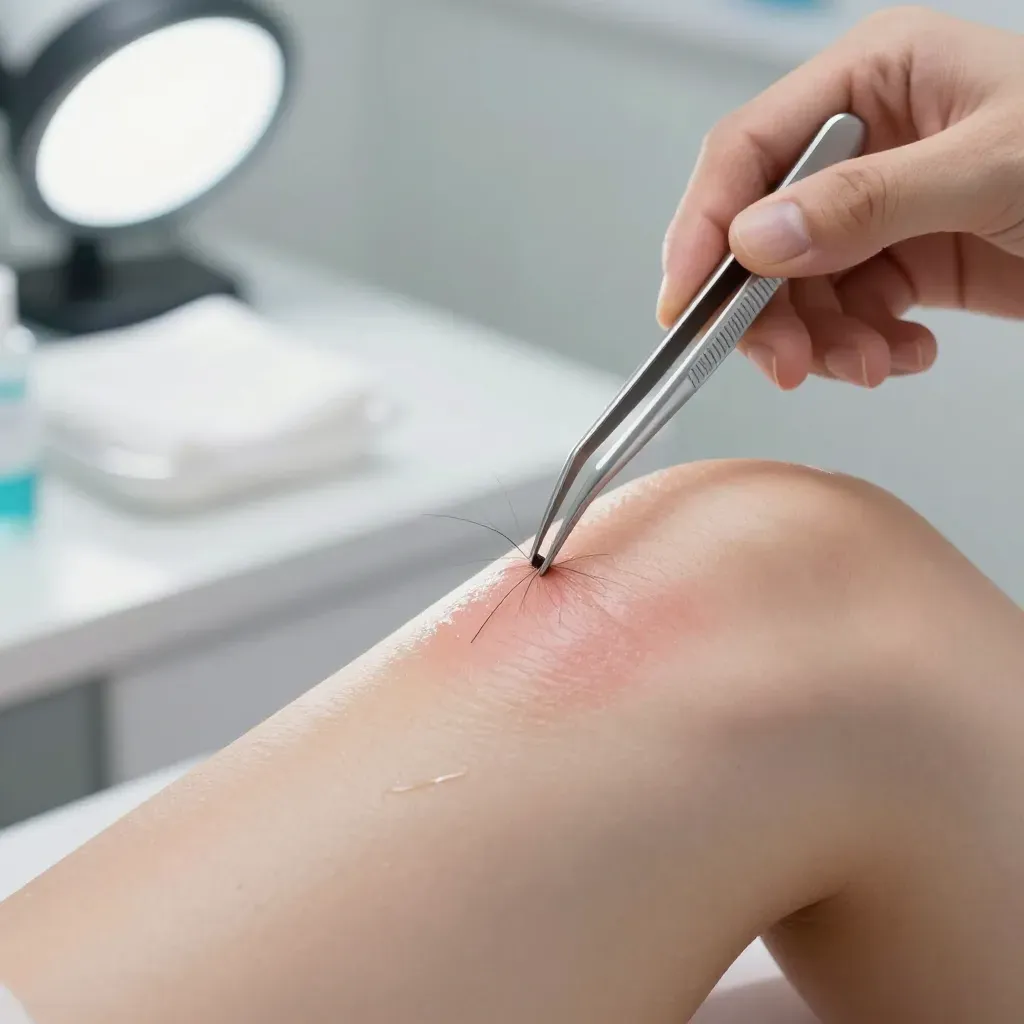
- Lift the hair. With pointed tweezers, gently tease the hair loop upward. Do not dig into the skin.
- Pull slowly. Grasp the hair at the base and pull in the direction of growth.
- Disinfect after. Apply a small amount of antibiotic ointment to the area.
When to stop and see a professional
Do not attempt home removal if | What it means |
|---|---|
Redness spreads beyond the bump | Infection is spreading |
Pus drains continuously | Abscess present |
Pain increases after 2-3 days | Getting worse not better |
Hair is deeply embedded | Risk of scarring if forced |
What actually causes infections
- Digging at the skin with dirty tools
- Pulling the hair out sideways instead of in its growth direction
- Popping or squeezing the bump
- Reusing non-sterilized tweezers
- Touching the area with dirty hands
If the ingrown hair does not emerge after a week of warm compresses leave it alone. The body will eventually push it out or the skin will heal over it. Forcing it creates the exact problem you are trying to avoid.
Chronic ingrown hairs signal a bigger issue. Repeated trauma from shaving and waxing keeps causing the problem. Laser hair removal eliminates the hair follicle entirely so the hair never grows back to become ingrown.
Why laser hair removal is the ultimate solution to stop ingrown hairs permanently
Every ingrown hair starts the same way. A hair gets cut below the surface and grows sideways into the skin. Shaving waxing and epilating all cause this. The only way to guarantee it never happens again is to stop the hair from growing.
How laser treatment stops ingrown hairs for good
- Light energy targets the pigment in the hair follicle
- The follicle gets damaged and can no longer produce hair
- No hair means no ingrown hair. Simple cause and effect
- Works on any area prone to ingrowns including bikini line legs beard and back
Laser vs traditional hair removal methods
Method | Ingrown risk | Longevity | Pain level |
|---|---|---|---|
Shaving | Very high | 1-3 days | Low |
Waxing | High | 2-4 weeks | High |
Tweezing | High | 1-3 weeks | Moderate |
Depilatory creams | Low | 1-2 weeks | Low |
Laser removal | None after completion | Permanent | Low to moderate |
People with coarse curly hair suffer most from ingrowns. The hair curls back into the skin almost immediately after cutting. This condition called pseudofolliculitis barbae is common on the beard area and bikini line. Laser beard removal eliminates the root cause entirely.
Professional clinics deliver the best results but FDA-approved home devices work for milder cases. Home devices use IPL technology which is less powerful but still effective with consistent use over several weeks.
The cost adds up over sessions but compare it to years of buying razors shaving cream ingrown treatments and potential doctor visits for infections. Professional laser outperforms at-home devices in speed and permanence but both beat the endless cycle of plucking and treating ingrowns.
No more warm compresses. No more sterilized tweezers. No more infection anxiety. The follicle is gone and the problem goes with it.