
Table of Contents
Men experience more ingrown hairs than women because they have coarser hair, thicker skin, and shave more frequently.
You can safely extract visible ingrown hairs at home using sterile tools, warm compresses, and chemical exfoliants.
Prevent razor bumps by softening your skin first, using sharp blades, and always shaving with the grain.
Effective prevention products include chemical exfoliants like salicylic acid and alcohol-free moisturizers.
Laser hair removal provides a permanent solution by destroying the hair follicle entirely.
Question | Answer |
|---|---|
Why do men get more ingrown hairs than women? | Male skin is thicker and produces coarser hair that easily curls back into the skin after shaving. |
What is the safest way to remove an ingrown hair at home? | Apply a warm compress and use a sterile needle to gently lift visible hairs without digging under the skin. |
How do I shave to prevent ingrown hairs? | Shave immediately after a warm shower, use a sharp blade, and always move in the direction of your hair growth. |
Which products actually prevent ingrown hairs? | Chemical exfoliants containing salicylic or glycolic acid clear dead skin to stop trapping hairs beneath the surface. |
Can laser hair removal permanently stop ingrown hairs? | Laser hair removal permanently destroys the hair follicle to completely eliminate the root cause of ingrown hairs. |
Why men get more ingrown hairs than women.
Hair Texture & Growth Patterns
Men naturally have thicker, coarser, and curlier body hair, especially on the neck, beard, and chest. This hair type is more likely to curl back into the skin after being cut.
Factor | Typical in Men | Effect on Ingrown Hairs |
|---|---|---|
Hair Diameter | Larger, coarser | Stronger curl tendency post-shave |
Hair Shape | More often curly or flat-oval | Increases risk of re-entry into skin |
Growth Cycle | Often faster, denser growth | More frequent shaving needed |
Shaving Practices & Frequency
Men shave more frequently and often on larger surface areas like the face and neck. Daily shaving cuts hair bluntly, creating a sharp tip that easily pierces the skin.
- Daily shaving prevents hair from growing long and soft naturally.
- Poor technique: shaving against grain, stretching skin taut.
- Dull razors cause uneven cuts and more skin irritation.
- No exfoliation: dead skin traps hairs.
Skin Thickness & Hormonal Factors
Male skin is about 25% thicker than female skin. Thicker skin can make it harder for a hair to break through the surface, increasing the chance it turns sideways. Higher testosterone levels also stimulate more robust hair growth and increased sebum production, which can clog follicles.
Beard Area Prone to Ingrowns
The neck and beard area are the most common sites for men. Hair here often grows in multiple, random directions. Shaving creates sharp, pointed stubble that can easily re-enter the skin at odd angles, especially along the jawline and Adam's apple where skin is taut.
Best at-home methods to remove ingrown hairs safely.
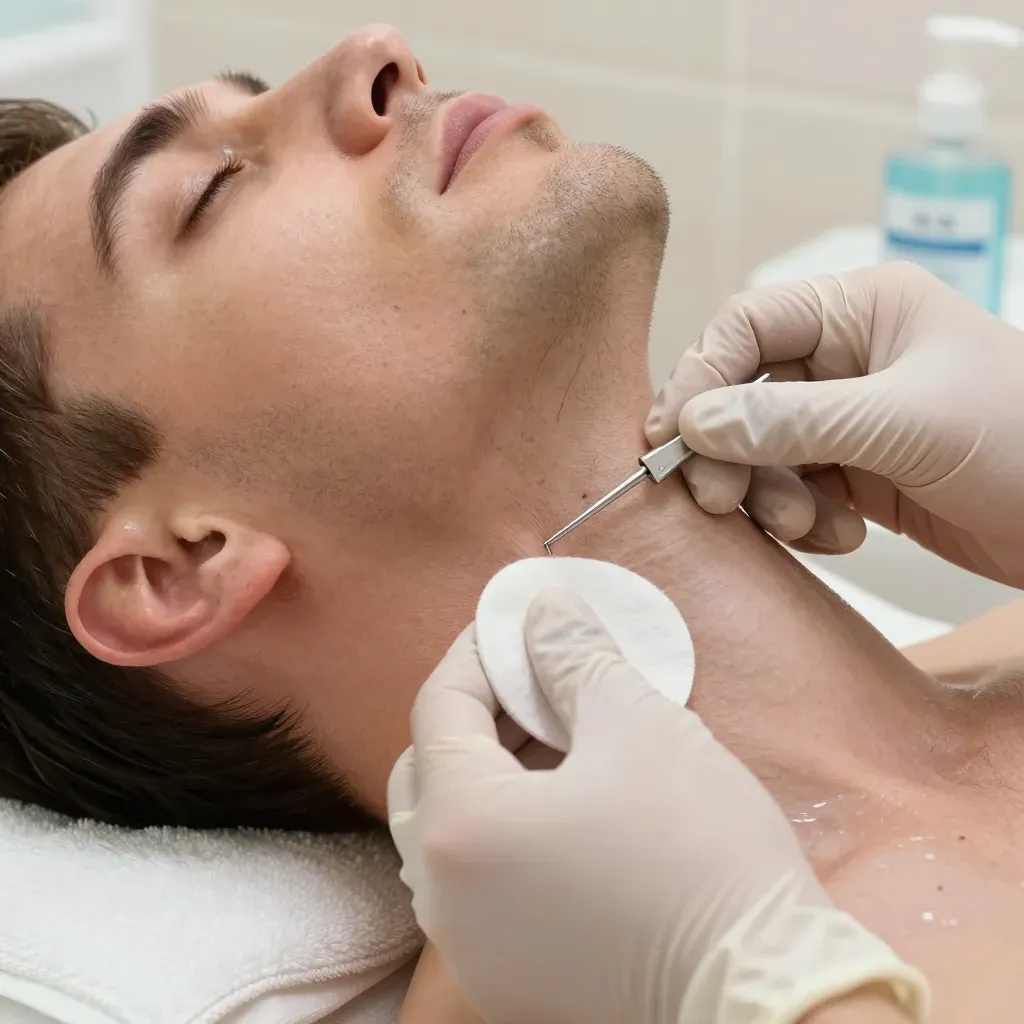
Use a sterile needle or tweezers for visible hairs only.
If the hair tip is clearly visible at the skin's surface, gently lift it with a sterilized needle or curved tweezers. Never dig under the skin. Cleanse the area with alcohol first and after. This method releases the hair without breaking the follicle.
Apply a warm compress to soften the skin.
Soak a clean washcloth in warm water and hold it against the ingrown hair for 5-10 minutes. This softens the skin and may allow the hair to surface naturally. Repeat 2-3 times daily before attempting removal.
Exfoliate gently with chemical or physical scrubs.
Use a gentle exfoliant containing salicylic acid or glycolic acid daily. These dissolve dead skin cells trapping the hair. For physical exfoliation, use a soft washcloth or a gentle scrub in circular motions. Avoid harsh scrubbing which causes more inflammation.
Method | Best For | Frequency |
|---|---|---|
Salicylic acid pads (e.g., Tend Skin) | Prevention and early ingrowns | Daily after shaving |
Warm compress | Encouraging hair to surface | 2-3 times daily |
Soft washcloth exfoliation | Loose dead skin buildup | Every other day |
Apply anti-inflammatory topicals.
Use products with benzoyl peroxide, tea tree oil, or witch hazel to reduce redness and swelling. These can help soothe the area and prevent infection. Apply with a cotton swab directly to the bump.
Stop if you encounter resistance or signs of infection.
If the hair is deeply embedded, painful, or the area becomes increasingly red, swollen, or pus-filled, stop all attempts. These are signs of infection requiring professional treatment. Do not try to dig out a deeply buried hair.
How to shave without causing razor bumps and ingrowns.
Prepare skin and hair properly.
Shave immediately after a warm shower or apply a warm, damp towel for 2-3 minutes. Softened hair requires less force and reduces the chance of a sharp, jagged cut that can curl back. Apply a quality shaving cream or gel and let it sit for a minute to further soften hair.
Shave with the grain, not against.
Always shave in the direction of hair growth. For the neck, this often means shaving downward. Shaving against the grain pulls the hair up before cutting it, creating a sharp, pointed tip that easily re-enters the skin. Use light, single passes. Do not press the razor hard into the skin.
Use a sharp, clean razor and replace blades often.
A dull blade tugs at hairs, causing uneven cuts and significant irritation. Replace disposable blades after 3-5 shaves. For multi-blade razors, clogging between blades increases skin irritation. Rinse the razor thoroughly after every stroke.
Minimize passes and avoid stretching skin.
Stretching the skin taut to get a closer shave is a major cause of ingrown hairs. It flattens the skin surface, allowing the razor to cut hair below the skin line. Let the skin relax. Use short, light strokes and rinse the blade frequently.
Rinse with cold water and moisturize immediately.
After shaving, rinse with cold water to close pores. Pat skin dry. Apply an alcohol-free moisturizer or aftershave balm containing ingredients like aloe, niacinamide, or witch hazel. This soothes irritation and keeps the skin barrier healthy, allowing hairs to emerge freely.
Key Shaving Do's and Don'ts
Do This | Not This |
|---|---|
Shave after a warm shower | Shave dry skin |
Use a sharp, single blade | Use dull, multi-blade razors |
Apply minimal pressure | Press razor into skin |
Shave in hair growth direction | Shave against the grain for closeness |
Moisturize with non-comedogenic product | Use heavy, pore-clogging lotions |
Products that actually prevent ingrown hairs.
Chemical Exfoliants
Salicylic acid and glycolic acid are the most effective ingredients for preventing ingrown hairs. They work by dissolving the dead skin cells that trap hairs beneath the surface. Apply as a toner or pad after shaving and before bed.
- Salicylic acid (0.5-2%): Penetrates pores, prevents clogging, reduces inflammation
- Glycolic acid (5-10%): Smooths skin surface, loosens embedded hairs
- Lactic acid: Gentle exfoliation, also moisturizes skin
Antibacterial and Anti-inflammatory Treatments
Products containing benzoyl peroxide, tea tree oil, or witch hazel reduce bacteria and inflammation around hair follicles. Use these on existing bumps to prevent worsening and new ones from forming.
Pre-Shave and Post-Shave Products
Use a dedicated pre-shave oil or scrub to soften hair and lift it from the skin before shaving. Post-shave treatments should be alcohol-free to avoid drying out the skin, which can worsen irritation.
Recommended Product Categories
Product Type | Key Ingredients | When to Use |
|---|---|---|
Exfoliating toner | Salicylic acid, glycolic acid | After every shave |
Ingrown hair serum | Benzoyl peroxide, tea tree oil | Nightly on affected areas |
Pre-shave scrub | Jojoba beads, sugar | Before shaving, 2-3 times weekly |
Aftershave balm | Aloe, niacinamide, witch hazel | Immediately after shaving |
Moisturizing sunscreen | Non-comedogenic formulas | Daily for exposed skin |
What to Avoid in Products
Steer clear of heavy pore-clogging ingredients like coconut oil, lanolin, and petroleum. Alcohol-based aftershaves strip the skin and can increase irritation. Fragranced products may cause allergic reactions on sensitive, freshly shaved skin.
Why laser hair removal is the permanent fix.
How laser hair removal works.
Laser targets melanin in the hair follicle. The concentrated light energy damages the follicle during its active growth phase. This inhibits future hair growth. Multiple sessions are required to catch all hairs in their growth cycle.
Why it eliminates ingrown hairs.
Laser destroys the hair root permanently. No hair means no hair can become ingrown. There is no blunt, sharp, or curly hair tip to grow sideways into the skin. The follicle itself is disabled.
- Stops hair at the source, not at the skin surface.
- No more shaving, waxing, or tweezing needed.
- Eliminates the sharp stubble that causes razor bumps.
Effectiveness and long-term results.
After a full series of treatments, most clients see 70-90% permanent hair reduction. Remaining hairs often grow back finer and lighter, posing almost no ingrown risk. Maintenance sessions once a year or less are common.
Considerations for best results.
Success depends on hair color, skin tone, and technology. Dark hair on light skin responds best. Newer lasers like diode and Nd:YAG work on darker skin tones. Hair must be present during treatment—do not pluck or wax between sessions.
Method | Ingrown Hair Risk | Longevity | Root Cause Addressed? |
|---|---|---|---|
Shaving | Very High | Days | No |
Waxing | High | Weeks | No |
Laser Hair Removal | Very Low (post-treatment) | Permanent Reduction | Yes |