
Table of Contents
Deep ingrown hairs sit far below the skin surface causing hard painful lumps.
This guide explains how to identify buried hairs and distinguish them from cysts or boils.
It covers safe home remedies like warm compresses and salicylic acid to draw the hair out naturally.
If the hair surfaces you learn the proper sterilized extraction technique to avoid scarring.
Know when to stop home treatment and see a doctor for stubborn or infected hairs.
Finally discover prevention tips including shaving adjustments and laser hair removal to stop ingrown hairs permanently.
Question | Answer |
|---|---|
How do I know if an ingrown hair is deep? | Deep ingrown hairs feel like hard lumps under the skin without a visible hair tip or whitehead. |
Can I dig out a deep ingrown hair? | Never dig or force a deep ingrown hair out because it pushes the hair deeper and causes infection. |
How long does it take for a deep ingrown hair to surface? | It often takes up to two weeks of consistent warm compresses and exfoliation to bring a deep hair to the surface. |
When should I see a doctor for an ingrown hair? | See a doctor if you see pus draining red streaks spreading or if the bump does not improve after two weeks. |
Does laser hair removal stop deep ingrown hairs? | Laser hair removal targets the follicle directly offering a permanent solution to stop chronic deep ingrown hairs. |
How to identify a very deep ingrown hair beneath your skin
Very deep ingrown hair removal starts with knowing what you're dealing with. A deeply embedded hair sits far below the surface unlike a shallow bump you can easily see.
Key signs that set deep ingrown hairs apart from other skin issues:
- Hard lump under the skin with no visible hair tip
- Dark spot beneath the surface indicating the curled hair
- Pain or tenderness when you press the area
- Skin looks normal or slightly red on top
- Swelling that persists for weeks
- No whitehead or pus visible at surface level
A deep ingrown hair feels different from a cyst or boil. Cysts are larger and more movable. Boils develop a visible head quickly. Deep ingrown hairs stay small firm and stuck in place.
Common mistaken diagnoses
Symptom | Deep Ingrown Hair | Something Else |
|---|---|---|
Tiny hard bump | Yes | Possible cyst |
Visible hair strand | Rarely | Surface ingrown |
Grows over weeks | Slow | Boil is faster |
Responds to warm compress | Partially | Usually yes |
Recurring in same spot | Common | Less common |
Check the area in bright light. Angle a flashlight sideways across the skin. This technique called transillumination can reveal the dark hair shaft buried underneath.
Run your finger over the lump. If you feel a thin rigid line beneath the swelling that's likely the hair curled back on itself.
Safe home remedies for very deep ingrown hair removal
Deep ingrown hairs often require weeks of preparation before extraction becomes possible. These remedies soften the skin and encourage the buried hair to rise closer to the surface naturally.
Warm compress method
- Soak a clean washcloth in warm water
- Wring out excess and place on the affected area
- Hold for 15-20 minutes repeating 3-4 times daily
- The heat expands pores and softens the hair trapped inside
- After several days the hair may surface enough to extract
Exfoliation techniques
Method | How Often | Best For |
|---|---|---|
Salicylic acid treatment | Once daily | Breaking down surface skin |
gentle scrub with sugar | 2-3 times weekly | Loosening trapped hairs |
Chemical exfoliant | Every other day | Thick skin areas |
Apply a thin layer of salicylic acid gel after warm compresses. This penetrates the skin and dissolves the debris around the embedded hair.
Oil treatment for stubborn cases
- Apply tea tree oil diluted with carrier oil (1:4 ratio)
- Leave on overnight to reduce inflammation
- Follow with warm compress in the morning
- Repeat for up to two weeks before trying extraction
If the hair hasn't surfaced after two weeks of consistent treatment stop home attempts and consult a dermatologist or aesthetician. Deep extraction requires professional tools and sterile conditions.
Step-by-step extraction methods for deep embedded hairs
Extract only after 10-14 days of home treatment. The hair must be visible or easily felt near the surface. Forcing extraction on a truly deep hair causes scarring and infection.
Essential preparation
- Wash hands thoroughly with soap and water
- Sterilize all tools with rubbing alcohol
- Cleanse the area with alcohol or antiseptic wipe
- Apply a warm compress for 10 minutes to soften skin
- Work in bright light with a magnifying mirror
Tool selection guide
Tool | Best For | Risk |
|---|---|---|
Fine-tipped tweezers | Hair tip visible above skin | Puncturing if angled wrong |
Sterile lancet | Opening a tiny hole over hair tip | Too deep causes more trauma |
Needle | Loosening hair coil beneath surface | Requires steady hand |
Extraction procedure
- Create an opening. If skin is intact use a sterile lancet to make a tiny slit directly over the hair tip. Angle the blade parallel to skin.
- Expose the hair. Gently tease away skin with a needle to reveal the curled hair end. Do not dig.
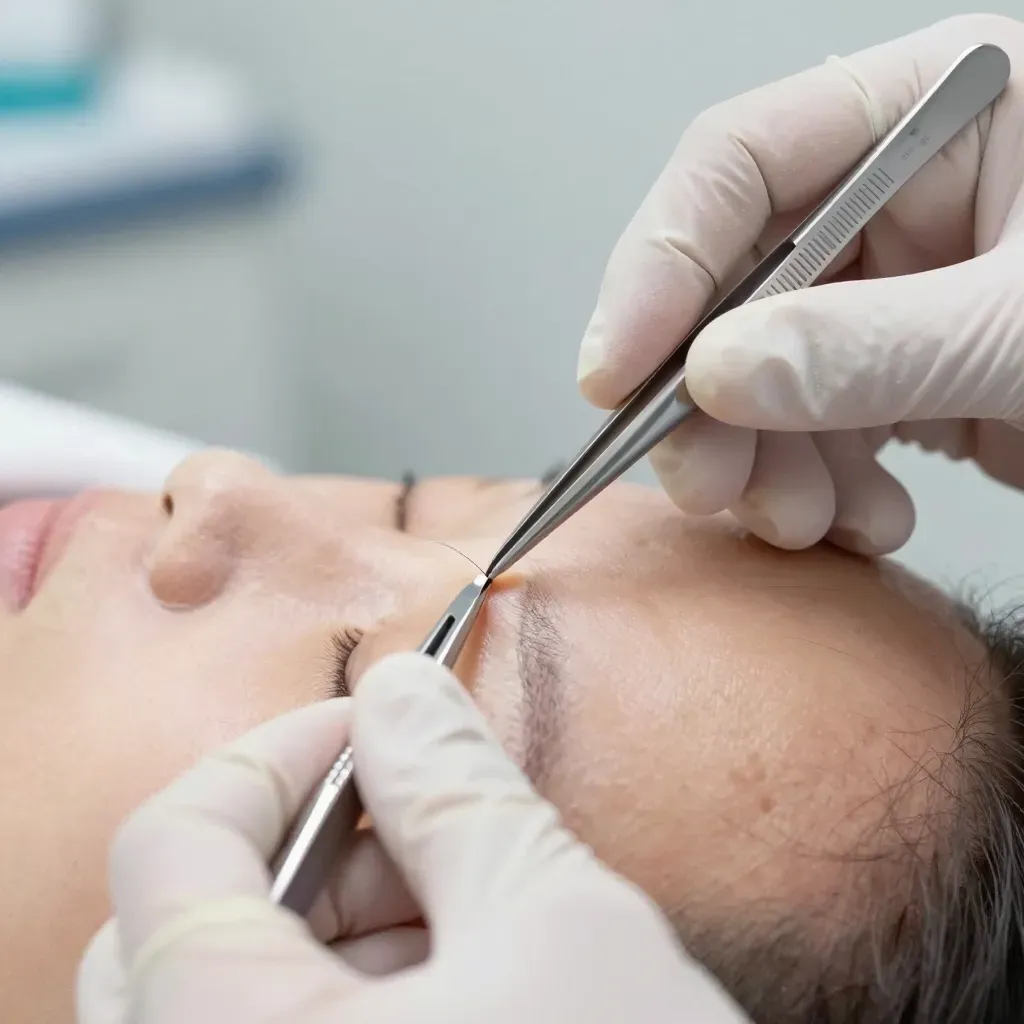
- Grab the hair. Use fine-tipped tweezers to grasp the hair as close to the root as possible. Grip firmly but not so tight you crush it.
- Pull steadily. Pull in the direction of hair growth with constant even pressure. Do not yank or twist.
- Stop if resistance is high. If the hair won't budge after 2-3 tries the hair is still too deep. Treat longer and try again later.
Immediate aftercare
- Apply pressure with clean tissue if bleeding occurs
- Clean the area again with alcohol or saline
- Apply a thin layer of antibiotic ointment
- Cover with a breathable bandage for 24 hours
- Do not apply makeup or lotions for 48 hours
When to see a doctor for deep ingrown hairs that won't surface
Home extraction fails when hairs sit too deep. Digging causes tissue damage and scarring. Know when to stop.
Warning signs of infection
- Pus draining from the bump
- Red streaks spreading outward
- Skin feels hot to touch
- Fever or chills develop
- Throbbing pain increases
Stop home treatment if you spot these symptoms. Infections spread fast.
When to get medical help
Situation | Action Needed |
|---|---|
No improvement after 2 weeks | Dermatologist evaluation |
Recurring cyst in same spot | Medical extraction and steroid shot |
Large painful boil forms | Doctor lancing and drainage |
Bump in genital area | Professional ingrown hair groin removal |
High-risk patients
See a doctor right away if you have specific health conditions.
- Diabetes
- Weakened immune system
- Poor blood circulation
- History of staph infections
Prevention tips to stop deep ingrown hairs from forming
Preventing deep ingrown hairs requires consistent habits. Most form when hair gets trapped by dead skin or grows into curled follicles.
Shaving habits that matter
- Shave in the direction of hair growth
- Use a single-blade razor to reduce skin irritation
- Replace blades every 5-7 shaves
- Apply shaving gel not soap to create a proper barrier
- Do not stretch the skin taut while shaving
- Avoid shaving over the same area multiple times
Exfoliation schedule
- Stimulates hair to grow outward
Alternative hair removal methods
Switching removal methods eliminates the root cause for most people.
- Laser hair removal targets the follicle directly so hair stops growing back. Check the most effective laser hair removal options for lasting results
- Waxing pulls hair from the root reducing curl-back risk
- Depilatory creams dissolve hair at skin level without cutting
Daily skin care
- Moisturize daily to keep skin soft and flexible
- Wear loose clothing in areas prone to ingrown hairs
- Apply essential oils for ingrown hair treatment after exfoliation to reduce inflammation
- Avoid tight underwear or leggings that trap sweat against skin